The Tay Viaduct, also known as the West Railway Bridge, is a single-track railway viaduct in Perth, Perth and Kinross, Scotland. It is around 440 m (1,440 ft) long. It carries the Scottish Central Railway, via a pronounced curve, across the River Tay to and from Perth railway station, 0.5 mi (800 m) to the west. Built in 1864, the work of London's Francis Freeman & Lee, it replaced an earlier double-track timber viaduct dating from 1849. The first pier of today's structure is for a double track, but the line is now single.

The viaduct has seven iron girder spans on the city side of the river, ten stone arches on Moncreiffe Island, and six iron girder spans to the east of Moncreiffe Island. The earlier bridge had 25 arches and an iron swing bridge. The bridge has two spans across the Tay from Perth: the first is to Moncreiffe Island; the second is from Moncreiffe Island to Barnhill on the river's eastern banks. It has a pedestrian walkway on the outer edge of its curve. The curve is less severe than its predecessor's was. The current structure has seventeen chains.

Nearby Places View Menu
Location Image
166 m

Perth Water Works

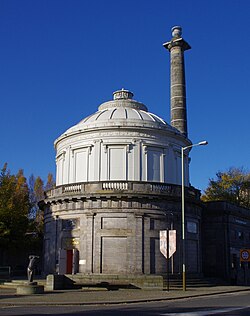
Perth Water Works (also known as Corporation Water Works) is an historic building in Perth, Scotland, dating to 1832. Standing at the corner of Tay Street and Marshall Place (both part of the A989), the building is a former engine house, water tank and art gallery. It was the home of The Fergusson Gallery, displaying the work of John Duncan Fergusson, since 1992. The collection has now been relocated to Perth Art Gallery, though a sculpture remains outside. The building is Category A listed. Historic Environment Scotland states that it is one of Scotland's most significant industrial buildings, and that its large-scale cast-iron construction may be the first very first in the world. Clean water was drawn from filter beds on Moncreiffe Island, in the adjacent River Tay, and pumped beneath the river, by a steam engine, into a 146,000 imperial gallons (660,000 L; 175,000 US gal) holding tank in the building's rotunda. The building's architect was Adam Anderson, the rector of Perth Academy. An inscription over the door in the rotunda reads Aquam Igne Et Aqua Haurio ("I draw water by fire and water"). The engine house has a tall Doric columned chimney, capped by a Roman urn (a fibreglass replica of the original, which was destroyed by a lightning strike in 1871). The building became surplus to requirements in 1965, when the city opened a new water works. It was restored in 1973, for use as a Tourist Information Centre, by James Morris and Robert Steedman, and then converted to its current use nineteen years later. Its dome was reconstructed in 2003 as part of a restoration funded by the Heritage Lottery, Historic Scotland and Perth and Kinross Council.
Location Image
227 m

62–72 Tay Street

62–72 Tay Street (also known as the County Buildings) is an historic row of buildings in Perth, Scotland. Designed by local architect John Young, the building is Category B listed, dating to 1881. Standing on Tay Street, the building was originally the museum home of the Perthshire Society of Natural Science, constructed in memory of Sir Thomas Moncreiffe, 7th Baronet, a past president of the society. The museum housed two exhibits: a local (or regional) collection (which contained a collection of the animals, plants and rocks to be found in Perthshire and the basin of the Tay) and The Type (or Index) Museum, which illustrated the main types of animals, plants and rocks. The museum was extended in 1895 by John Young's son, George Penrose Kennedy Young. In 1902, the museum and its collection were given to the town council. The museum closed in 1934, and its artefacts moved to Perth Museum and Art Gallery on nearby George Street. The building subsequently became a Masonic Hall. A Masonic insignia is carved into the doorpiece. The northern end of the building (numbers 68–72) were destroyed by a fire in 1987. Number 63 is the home of restaurant 63 Tay Street, owned by Graeme Pallister.
Location Image
256 m

Perth Princes Street railway station

Perth Princes Street railway station served the city of Perth, Perth and Kinross, Scotland, from 1847 to 1966 on the Dundee and Perth Railway.
Location Image
279 m

Greyfriars, Perth

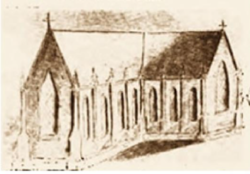
The Observant Order of Greyfriars (or Greyfriars) was a friary of the Franciscan Order located in the Scottish city of Perth. It was founded by Laurence Oliphant, 1st Lord Oliphant, in 1496 and destroyed on 11 May 1559 following the Scottish Reformation, started by John Knox in his sermon at Perth's St John's Kirk, just a few hundred yards to the north. The monastery's location is now partly occupied by the Greyfriars Burial Ground, established in 1580. In 1997, when proposals were made to dismantle and rebuild the cemetery's eastern wall, two test pits were dug by the Scottish Urban Archaeological Trust (SUAT). One of the pits found what is believed to be the original monastery wall foundations. A "succession of wall foundations" hinted at several wall replacement and repair efforts undertaken during the monastery's lifespan, each raising the ground level. Medieval pottery was also discovered, likely associated with the soil of lower garden abutting the original monastery wall. The other pit demonstrated a lack of a progression of wall foundations, confirming that that area was inside the 1795 graveyard extension and outside the original monastery grounds. The second pit also showed signs of infilling or levelling layers, possibly from when a burn, which ran along the burial ground's southern wall, was covered with soil.