Location Image

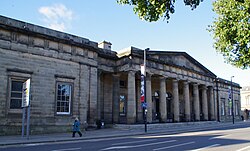
62–72 Tay Street

62–72 Tay Street (also known as the County Buildings) is an historic row of buildings in Perth, Scotland. Designed by local architect John Young, the building is Category B listed, dating to 1881. Standing on Tay Street, the building was originally the museum home of the Perthshire Society of Natural Science, constructed in memory of Sir Thomas Moncreiffe, 7th Baronet, a past president of the society. The museum housed two exhibits: a local (or regional) collection (which contained a collection of the animals, plants and rocks to be found in Perthshire and the basin of the Tay) and The Type (or Index) Museum, which illustrated the main types of animals, plants and rocks. The museum was extended in 1895 by John Young's son, George Penrose Kennedy Young. In 1902, the museum and its collection were given to the town council. The museum closed in 1934, and its artefacts moved to Perth Museum and Art Gallery on nearby George Street. The building subsequently became a Masonic Hall. A Masonic insignia is carved into the doorpiece. The northern end of the building (numbers 68–72) were destroyed by a fire in 1987. Number 63 is the home of restaurant 63 Tay Street, owned by Graeme Pallister.

Lieux à Proximité Voir Menu
Location Image
67 m

Greyfriars, Perth

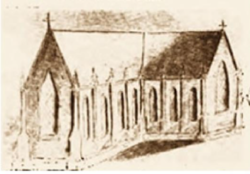
The Observant Order of Greyfriars (or Greyfriars) was a friary of the Franciscan Order located in the Scottish city of Perth. It was founded by Laurence Oliphant, 1st Lord Oliphant, in 1496 and destroyed on 11 May 1559 following the Scottish Reformation, started by John Knox in his sermon at Perth's St John's Kirk, just a few hundred yards to the north. The monastery's location is now partly occupied by the Greyfriars Burial Ground, established in 1580. In 1997, when proposals were made to dismantle and rebuild the cemetery's eastern wall, two test pits were dug by the Scottish Urban Archaeological Trust (SUAT). One of the pits found what is believed to be the original monastery wall foundations. A "succession of wall foundations" hinted at several wall replacement and repair efforts undertaken during the monastery's lifespan, each raising the ground level. Medieval pottery was also discovered, likely associated with the soil of lower garden abutting the original monastery wall. The other pit demonstrated a lack of a progression of wall foundations, confirming that that area was inside the 1795 graveyard extension and outside the original monastery grounds. The second pit also showed signs of infilling or levelling layers, possibly from when a burn, which ran along the burial ground's southern wall, was covered with soil.
Location Image
67 m

Greyfriars Burial Ground

Greyfriars Burial Ground is an historic cemetery in Perth, Scotland. Dating to 1580, it is now Category A listed, with its collection of gravestones considered one of the best in Scotland. The cemetery closed to burials in 1978. The cemetery occupies the former location of the Greyfriars Monastery, founded by Laurence Oliphant, 1st Lord Oliphant, in 1496 and destroyed in 1559 at the start of the Scottish Reformation. As per documentation dating to 1911, "no burial is permitted of the body of a person who at the time of death resided out of the old parish, excepting that of a widower or widow, son or daughter who have never been married." A superintendent was in attendance every morning between 10 and 11 AM, then between 11 AM and 1 PM at Wellshill Cemetery. The cemetery is located at the eastern end of Canal Street, near its junction with Tay Street. It has been extended south on two occasions, and it now abuts the bridge carrying the Perth-to-Dundee section of the Scottish railway network. Also on the southern side of the cemetery is a roofed section under which are thirteen early gravestones. Moved for conservation purposes, they include the oldest gravestone in the cemetery (Buchan, 1580). A tablet commemorating John Mylne, who "rebuilt the ancient bridge over the River Tay," was erected by Robert Mylne in 1784. In 1997, when proposals were made to dismantle and rebuild the cemetery's eastern wall, two test pits were dug by the Scottish Urban Archaeological Trust (SUAT). One of the pits found what is believed to be the original monastery wall foundations. A "succession of wall foundations" hinted at several wall replacement and repair efforts undertaken during the monastery's lifespan, each raising the ground level. Medieval pottery was also discovered, likely associated with the soil of lower garden abutting the original monastery wall. The other pit demonstrated a lack of a progression of wall foundations, confirming that that area was inside the 1795 graveyard extension and outside the original monastery grounds. The second pit also showed signs of infilling or levelling layers, possibly from when a burn, which ran along the burial ground's southern wall, was covered with soil. In 2019, several headstones deemed a hazard to passersby were removed and restored. Perth and Kinross Council have left the grass outwith the paths around the graveyard to grow as a biodiversity plan.
Location Image
119 m

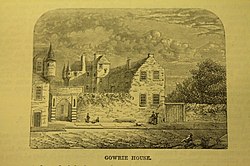
Gowrie House (Perth, Scotland)

Gowrie House was a mansion in the centre of Perth, Scotland, which was in existence between the 16th and 18th centuries. It was the scene of a controversial incident on 5 August 1600, and was later converted to army barracks.
Location Image
119 m

Perth Sheriff Court

Perth Sheriff Court is an historic building on Tay Street in Perth, Perth and Kinross, Scotland. The structure, which is used as the main courthouse for the area, is a Category A listed building.