

 English
 Français

Rottington
Rottington is a hamlet and former civil parish which is 3 miles (4.8 km) from Whitehaven; now in the parish of St Bees, Cumberland, Cumbria, England. It has a population of 51.
Lieux à Proximité Voir Menu

1.8 km
Sandwith, Cumbria
Sandwith is a settlement and former civil parish in Cumbria, England, about 7 miles from Workington and near St Bees. It lies in the parish of Whitehaven, in Cumberland unitary authority area. Sandwith was also a ward; in 2011 the ward had a population of 2463. In 1931, the parish had a population of 332.
1.8 km
St Bees Head
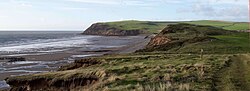
St Bees Head is a headland on the North West coast of the English county of Cumbria and is named after the nearby village of St Bees.
It is the only stretch of Heritage Coast on the English coastline between the Welsh and Scottish borders, and is a Site of Special Scientific Interest. The sea off the Head is protected as part of the Cumbria Coast Marine Conservation Zone.
It lies on two long-distance footpaths, the Cumbria Coastal Way and Alfred Wainwright's Coast to Coast Walk. Both long-distance footpaths follow the edge of the cliffs, which rise to 90 metres above sea level and have views of the Cumbrian mountains and coast.

2.4 km
St Bees Lighthouse
St Bees Lighthouse is a lighthouse located on St Bees Head near the village of St Bees in Cumbria, England. The cliff-top light is the highest in England at 102 m (335 ft) above sea level.
2.5 km
Woodhouse Colliery
Woodhouse Colliery, also known as Whitehaven coal mine, was a proposed coal mine near to Whitehaven in Cumbria, England. The coal mine had been advertised as bringing jobs to a deprived area, but had also come in for criticism by green campaigners.
The mine was proposed by West Cumbria Mining and planned to extract coking coal from beneath the Irish Sea for 25 years. The plan was criticised by some MPs, scientists and environmentalists due to the coal mine's environmental impact and the British government's legal commitments to reduce carbon emissions.
The planning application had been under consideration since 2019, when Cumbria County Council granted planning permission for the venture.
The colliery would have been the first new deep coal mine in the United Kingdom in 30 years (the last such development was the Asfordby pit in 1986). It is not to be confused with the former Woodhouse Close Colliery in Woodhouse Close, Bishop Auckland (County Durham) which operated between 1835 and 1934.
The government initially took the view that the decision should be a local one, but became involved in March 2021, putting the project on hold. There was speculation that Robert Jenrick, the Secretary of State involved, was influenced by the forthcoming United Nations Climate Change Conference, held that year in Glasgow, but he did not give a reason. Michael Gove, Jenrick's successor as Secretary of State, gave planning consent in December 2022, but faced legal challenges which had not been resolved by the time of the 2024 United Kingdom general election.
After the election, as well as uncertainty about the outcome of the court case, there was some uncertainty about whether the incoming Labour government would oppose the project. However, shortly before the court hearing, the new Secretary of State expressed the view that the previous government's decision to approve Woodhouse Colliery was unlawful because emissions had not been taken into consideration.
On 31 March 2025, West Cumbria Mining withdrew its planning application for Woodhouse Colliery at Whitehaven after the High Court had quashed the mine’s 2022 approval in September 2024 for failing to consider downstream greenhouse‑gas emissions, effectively cancelling what would have been the United Kingdom’s first deep coal mine in more than three decades. Environmental organisations, including Friends of the Earth and South Lakes Action on Climate Change, welcomed the decision and called for investment in well‑paid, low‑carbon jobs for the region, ensuring West Cumbria benefits from the transition away from coal.