

 English
 Français

The Former Military Chapel (Bachelor Quarters) is a building on Alcatraz Island off the coast of San Francisco, United States. It is located next to the Sally Port and Dock and the Building 64 residential apartments. It was built in the 1920s in the mission-revival style to accommodate for the officers at the military prison on the island. The ground floor had quarters for the officers and their families who worked at the military prison and the top floor was used as a school and chapel. In 1934, when Alcatraz became a Federal Penitentiary, the building was used as a Bachelor Quarters for unmarried officers.
1. References
Nearby Places View Menu

58 m
Alcatraz Hospital
Alcatraz Hospital is a defunct hospital which was located on Alcatraz Island, California, US. It began operations in the 19th century while the United States Army operated Fort Alcatraz and continued to provide services after the transition to the Alcatraz Federal Penitentiary. Though Alcatraz is now part of the Golden Gate National Recreation Area, the hospital is not included on the general tour.

58 m
Alcatraz Dining Hall
Alcatraz Dining Hall, often referred to as the Mess Hall, is the dining hall of Alcatraz Federal Penitentiary where the prisoners and staff ate their meals. It is a long wing on the west end of the Main Cellhouse of Alcatraz, situated in the center of the island. It is connected to the block by a corridor known as "Times Square", as it passes beneath a large clock approaching the entrance way to the dining hall. This wing includes the dining hall and the kitchen beyond it.
66 m
Alcatraz Island
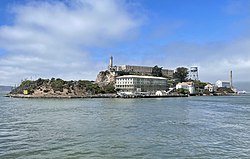
Alcatraz Island () is a small island about 1.25 miles offshore from San Francisco in San Francisco Bay, California, near the Golden Gate Strait. The island was developed in the mid-19th century with facilities for a lighthouse, a military fortification, and a military prison. In 1934, the island was converted into a federal prison, Alcatraz Federal Penitentiary. The strong tidal currents around the island and ice-cold water temperatures made escape nearly impossible, giving the prison one of the most notorious reputations of its kind in American history. The prison closed on March 21, 1963, leaving the island a major tourist attraction today with nearly 1.4 million people visiting the island annually.
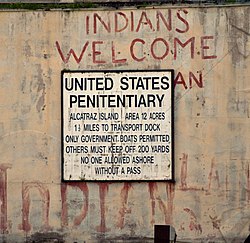
Beginning in November 1969, the island was occupied for more than 19 months by a group of Native Americans, initially primarily from San Francisco, who were later joined by the American Indian Movement and other urban Native Americans from other parts of the country, who were part of a wave of Native American activists organizing public protests across the US through the 1970s. In 1972, Alcatraz was transferred to the Department of Interior to become part of Golden Gate National Recreation Area. It was designated as a National Historic Landmark in 1986.
Today, the island's facilities are managed by the National Park Service as part of Golden Gate National Recreation Area. Visitors can reach the island by ferry ride from Pier 33, located between the San Francisco Ferry Building and Fisherman's Wharf. Hornblower Cruises, operating under the name Alcatraz City Cruises, is the official ferry provider to and from the island.
Alcatraz Island is the site of the abandoned federal prison, the oldest operating lighthouse on the West Coast of the United States, early military fortifications, and natural features such as rock pools and a seabird colony (mostly western gulls, cormorants, and egrets). According to a 1971 documentary on the history of Alcatraz, the island measures 1,675 feet (511 m) by 590 feet (180 m) and is 135 feet (41 m) at highest point during mean tide. The total area of the island is reported to be 22 acres (8.9 ha).
Landmarks on the island include the Main Cellhouse, Dining Hall, Lighthouse, the ruins of the Warden's House and Social Hall, Parade Grounds, Building 64, Water Tower, New Industries Building, Model Industries Building, and the Recreation Yard.
66 m
Occupation of Alcatraz
The Occupation of Alcatraz (November 20, 1969 – June 11, 1971) was a 19-month long occupation of Alcatraz Island and its prison complex, then classified as abandoned surplus federal land, by 89 American Indians and their supporters. The occupation was led by Richard Oakes, LaNada Means, and others, while John Trudell served as spokesman. The group lived on the island together until the occupation was forcibly ended by the U.S. government.
The protest group chose the name Indians of All Tribes (IAT) for themselves. IAT claimed that, under the Treaty of Fort Laramie (1868) between the U.S. and the Lakota tribe, all retired, abandoned, or out-of-use federal land was to be returned to the Indigenous peoples who once occupied it. As Alcatraz penitentiary had been closed on March 21, 1963, and the island had been declared surplus federal property in 1964, a number of Red Power activists felt that the island qualified for a reclamation by American Indians.
The Occupation of Alcatraz had a brief effect on federal Indian Termination policies and established a precedent for American Indian activism. Oakes was later shot to death in 1972. The American Indian Movement was targeted by the federal government and FBI in COINTELPRO and similar surveillance operations.