

 English
 Français
Baretrees, Greater Manchester
Baretrees (or Bare Trees) is a residential area of Chadderton in the Metropolitan Borough of Oldham, in Greater Manchester, England. It takes its name from a former hamlet in the north east of the town in what is now the Laburnum Avenue area. A local primary school, Bare Trees, bears the locality's name on nearby Holly Grove. Bare Trees also has an active residents association. One of the fifteen fatalities of the Peterloo Massacre, Thomas Buckley, was from the hamlet of Bare Trees. Buckley, a gardener aged 62, was described by his neighbours as a 'person fanciful to the fruit garden, a staunch patriot, an enemy to oppression'. Buckley was bayoneted and slashed by a sabre.
Nearby Places View Menu

252 m
Kent Mill, Chadderton
Kent Mill, Chadderton was a cotton spinning mill in Chadderton, Oldham, Greater Manchester. It was built in 1908 for the Kent Mill Co. It was taken over by the Lancashire Cotton Corporation in 1938 and passed to Courtaulds in 1964. Production finished in 1991 and it was demolished in 1994.

273 m
Manor Mill, Chadderton
Manor Mill, Chadderton is an early twentieth century, five storey cotton spinning mill in Chadderton, Oldham, Greater Manchester. It was built in 1906. It was taken over by the Lancashire Cotton Corporation in the 1930s and passed to Courtaulds in 1964. Production finished in 1990.

361 m
Chadderton F.C.
Chadderton Football Club is a football club in based in Chadderton, Oldham, Greater Manchester. They are currently members of the North West Counties League Premier Division and play at Andrew Street.
426 m
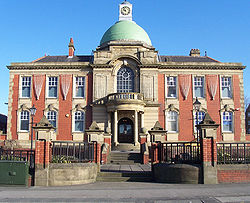
Chadderton
Chadderton is a town in the Metropolitan Borough of Oldham, Greater Manchester, England, on the River Irk and Rochdale Canal. It is located in the foothills of the Pennines, 1 mile (1.6 km) west of Oldham, 5 miles (8.0 km) south of Rochdale and 6 miles (9.7 km) north-east of Manchester. The town is near the A627(M) motorway.
Historically part of Lancashire, Chadderton's early history is marked by its status as a manorial township, with its own lords, who included the Asshetons, Chethams, Radclyffes and Traffords. Chadderton in the Middle Ages was chiefly distinguished by two mansions, Foxdenton Hall and Chadderton Hall, and by the families who occupied them. Farming was the main industry of the area, with locals supplementing their incomes by hand-loom woollen weaving in the domestic system.
Chadderton's urbanisation coincided largely with developments in textile manufacture during the Industrial Revolution. A late-19th century factory-building boom transformed Chadderton from a rural township into a major mill town and the second most populous urban district in the United Kingdom. More than 50 cotton mills had been built in Chadderton by 1914. Although Chadderton's industries declined in the mid-20th century, the town continued to grow as a result of suburbanisation and urban renewal. The legacy of the town's industrial past remains visible in its landscape of red-brick cotton mills.