

 English
 Français
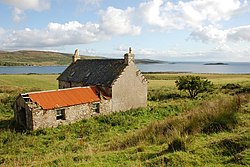
Danna (Écosse)
Danna est une île du Royaume-Uni située en Écosse, dans les Hébrides intérieures, entourée au nord et à l'est par le Knapdale, une péninsule de la Grande-Bretagne qui se prolonge au sud par le Kintyre.
Portail de l’Écosse Portail des îles
Nearby Places View Menu
0 m

2.0 km
Keills Chapel
Keills Chapel is a small chapel located in the west Highlands, Scotland, near the village of Tayvallich, Knapdale.
The chapel dates from the 11th century and is in the care of Historic Scotland as is Kilmory Knap Chapel on the opposite shore of Loch Sween. It is open at all reasonable times and there is no entrance charge.

3.5 km
Kilmory Knap Chapel
Kilmory Knap Chapel is a 13th-century Christian chapel, located at the tiny hamlet of Kilmory, in Knapdale, Argyll and Bute, on the west coast of Scotland.
Kilmory Knap Chapel is on Ellary Estate, next to Loch Sween, on the opposite shore to Keills Chapel. When the roof was lost the building was used as a burial enclosure. The structure was re-roofed in 1934 to hold a large collection of Early Christian cross slabs, late medieval graveslabs and standing crosses of West Highland type, from the 14th to 16th centuries. The chapel is an important historical site of Clan Macmillan (of Knap). In the church is Macmillan's Cross, a well-preserved piece of medieval carving, portraying the Chief of the clan with hunting dogs. The chapel and cross are cared for by Historic Scotland on behalf of the State and are a scheduled monument.
Simon Brighton associates Kilmory Knap Chapel with the Knights Templar, suggesting the area may have given refuge to Templars fleeing persecution in France.

3.5 km
Kilmory, Knapdale
Kilmory (Scottish Gaelic: Cill Mhoire) is a hamlet in the civil parish of South Knapdale, on Knapdale, Argyll and Bute, Scotland. It is situated near the mouth of Loch Sween on its southern shores. In 1961 it had a population of 81.
Kilmory Knap Chapel, located around 1,700 feet (520 m) northeast of Kilmory Beach, dates to the 13th century.
Three schools, established by the Society in Scotland for Propagating Christian Knowledge (SSPCK), existed here in the 19th century.

3.8 km
Loch Sween
Loch Sween (Scottish Gaelic: Loch Suain or Loch Suibhne) is a sea loch located near Lochgilphead, Argyll and Bute, Scotland. Castle Sween is located on the southern shore towards the seaward end of the loch. The village of Tayvallich, a favoured haven for water craft as it sits at the head of sheltered Loch a' Bhealaich, lies on the northern shore.
The shape of the loch, which is oriented from south west to north east, is complex. The inner, eastern end has several inlets. Caol Scotnish is a very narrow finger that reaches further north and east than the main body of water. Loch a' Bhealaich is to its south and west. There is the small, bridged embayment of Loch Craiglin on the south side of the inner loch and another larger inlet incorporating Bàgh na h-Araich Glaise that leads to the settlement of Achnamara. Linne Mhuirich is a long narrow inlet about halfway down the loch on the north side. The bay of Ceann an t-Sàilein lies between the Island of Danna and the main loch at the western end. Danna is now joined to the mainland by a causeway but at one time small craft could have travelled from Loch Sween into Loch na Cille to the north.
There are a variety of islands on the northern shore. Close to Danna are the islets of Eilean à Chapuill, Eilean nan Uan and Liath Eilean. The low-lying Ulva Islands and Taynish Island are farther east. Cala and Eilean Loain are on the southern shore further east with tidal Eilean Mhartan and tiny Sgeir Dubh beyond them in the Araich Glaise inlet. The Fairy Islands, including Eilean a' Bhrein are in yet another inlet to the north and Eilean na Circe, which contains the ruins of a "fortified dwelling" is in the confines of Caol Scotnish.
The inner loch contains maerl beds and burrowed mud, and supports a colony of volcano worm, whilst the sea bed in the more strongly tidal areas at the mouth of the loch is composed of coarser sediments. The loch is also home to one of Scotland's most important populations of native oyster.
Loch Sween was designated as a Nature Conservation Marine Protected Area (NCMPA) in 2014, and is considered to be a Category IV protected area by the International Union for Conservation of Nature.