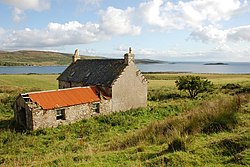
Loch Sween (Scottish Gaelic: Loch Suain or Loch Suibhne) is a sea loch located near Lochgilphead, Argyll and Bute, Scotland. Castle Sween is located on the southern shore towards the seaward end of the loch. The village of Tayvallich, a favoured haven for water craft as it sits at the head of sheltered Loch a' Bhealaich, lies on the northern shore. The shape of the loch, which is oriented from south west to north east, is complex. The inner, eastern end has several inlets. Caol Scotnish is a very narrow finger that reaches further north and east than the main body of water. Loch a' Bhealaich is to its south and west. There is the small, bridged embayment of Loch Craiglin on the south side of the inner loch and another larger inlet incorporating Bàgh na h-Araich Glaise that leads to the settlement of Achnamara. Linne Mhuirich is a long narrow inlet about halfway down the loch on the north side. The bay of Ceann an t-Sàilein lies between the Island of Danna and the main loch at the western end. Danna is now joined to the mainland by a causeway but at one time small craft could have travelled from Loch Sween into Loch na Cille to the north.

There are a variety of islands on the northern shore. Close to Danna are the islets of Eilean à Chapuill, Eilean nan Uan and Liath Eilean. The low-lying Ulva Islands and Taynish Island are farther east. Cala and Eilean Loain are on the southern shore further east with tidal Eilean Mhartan and tiny Sgeir Dubh beyond them in the Araich Glaise inlet. The Fairy Islands, including Eilean a' Bhrein are in yet another inlet to the north and Eilean na Circe, which contains the ruins of a "fortified dwelling" is in the confines of Caol Scotnish. The inner loch contains maerl beds and burrowed mud, and supports a colony of volcano worm, whilst the sea bed in the more strongly tidal areas at the mouth of the loch is composed of coarser sediments. The loch is also home to one of Scotland's most important populations of native oyster. Loch Sween was designated as a Nature Conservation Marine Protected Area (NCMPA) in 2014, and is considered to be a Category IV protected area by the International Union for Conservation of Nature.

Nearby Places View Menu
Location Image
3.4 km

Keills Chapel

Keills Chapel is a small chapel located in the west Highlands, Scotland, near the village of Tayvallich, Knapdale. The chapel dates from the 11th century and is in the care of Historic Scotland as is Kilmory Knap Chapel on the opposite shore of Loch Sween. It is open at all reasonable times and there is no entrance charge.
Location Image
3.8 km

Danna, Scotland

Danna (Scottish Gaelic: Danna) is an inhabited tidal island in Argyll and Bute.
Location Image
4.3 km

Taynish National Nature Reserve

Taynish National Nature Reserve (Scottish Gaelic: Tèarmann Nàdair Nàiseanta Taighnis) is situated southwest of the village of Tayvallich in the council area of Argyll and Bute on the west coast of Scotland. The reserve encompasses almost all of the Taynish peninsula, which is around 5 km long and 1 km wide. The woodlands at Taynish are often described as a 'temperate rainforest', benefiting from the mild and moist climate brought about by the Gulf Stream. Taynish is owned and managed by NatureScot and was declared a national nature reserve (NNR) in 1977. The reserve was formerly also a biosphere reserve, but this status was withdrawn in 2014. NatureScot provide a car park and three waymarked trails for visitors, the Barr Mòr Trail, Woodland Trail and the Coastal Trail. In 2015 it was estimated that around 9,500 people visited the reserve each year, down from a high of over 10,000 visitors in 2009/10.
Location Image
5.3 km

Eilean Loain

Eilean Loain is a small island in Loch Sween and one of the Inner Hebrides of Scotland. It is about 2 kilometres (1 mi) west of the settlement of Kilmichael of Inverlussa in Knapdale and a similar distance southeast of the village of Tayvallich on the other side of the loch. It is attended by the islet of Cala that lies to the north west. Eilean Loain has a substantial jetty on the north shore and a large building nearby. It was described as "inhabited" by Haswell-Smith in 2004 and Argyll and Bute Council records indicate the presence of a dwelling house. According to the National Records of Scotland census information the island is "included in the NRS statistical geography for inhabited islands but had no usual residents at the time of either the 2001 or 2011 censuses". However, in 2022 the census recorded a resident population of two. Eilean Loain is part of the Knapdale National Scenic Area, one of 40 in Scotland.