

 English
 Français

Kisdon
Kisdon, also called Kisdon Hill, is a fell situated in upper Swaledale in the Yorkshire Dales National Park in North Yorkshire, England.
Nearby Places View Menu

705 m
Angram Bottoms
Angram Bottoms (grid reference SD891999) is a 9.8 hectares (24 acres) biological Site of Special Scientific Interest (SSSI) near to the village of Angram in the Yorkshire Dales, England. The SSSI was first notified in 1989 and is due to the wet and dry grassland habitats which are unusual in the Yorkshire Dales.

988 m
Catrake Force
Catrake Force is a waterfall on the River Swale in North Yorkshire, England. It is not visible from the road but is accessible via a campsite in Keld. It comprises a series of four steps, each its own small waterfall, and each with a very different character – the largest single drop being about 20 feet (6.1 m).
It lies just upstream of Keld, downstream from Wain Wath Force. The next waterfall downstream is Kisdon Force. Waterfalls in the north of England are often termed Forces after the Norse word Foss which means waterfall, whilst Catrake derives from the Latin cataracta (waterfall) via Middle English.

1.1 km
Angram, Muker
Angram is a hamlet in the Yorkshire Dales in the county of North Yorkshire, England. It is near Keld to the north and Thwaite to the south. Angram forms part of the civil parish of Muker.
1.2 km
Arn Gill (North Yorkshire)
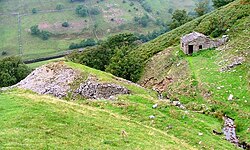
Arn Gill is a ravine or gully containing a beck of the same name, near the village of Muker in Swaledale, North Yorkshire, England. The ravine and beck run steeply downhill from the stream's source in Arn Gill Head, and the beck disgorges into the River Swale below.
The ravine contains remnants of the former Adelaide Level lead mine, which is named after Lady Adelaide Lamont, a descendant of Judge Jeffreys. In 1865 a strike was made there, which yielded about £12,000 (equivalent to £1,449,217 in 2023) worth of galena or lead ore. The mine closed in 1920. Miners worked in bad conditions in North Yorkshire lead mines during the Adelaide Level's era, with over 62% of local mines having extremely impure air. The most common occupational disease for miners was silicosis.