Location Image

Cathédrale catholique romaine Sainte-Marie d'Édimbourg

La cathédrale catholique romaine Sainte-Marie d'Édimbourg dédiée à Notre-Dame-de-l'Assomption (en anglais : St Mary's Metropolitan Cathedral of Our Lady of the Assumption) est une cathédrale catholique située à Édimbourg, en Écosse. Elle est le siège de l'archevêché catholique romain de Saint Andrews et Édimbourg.

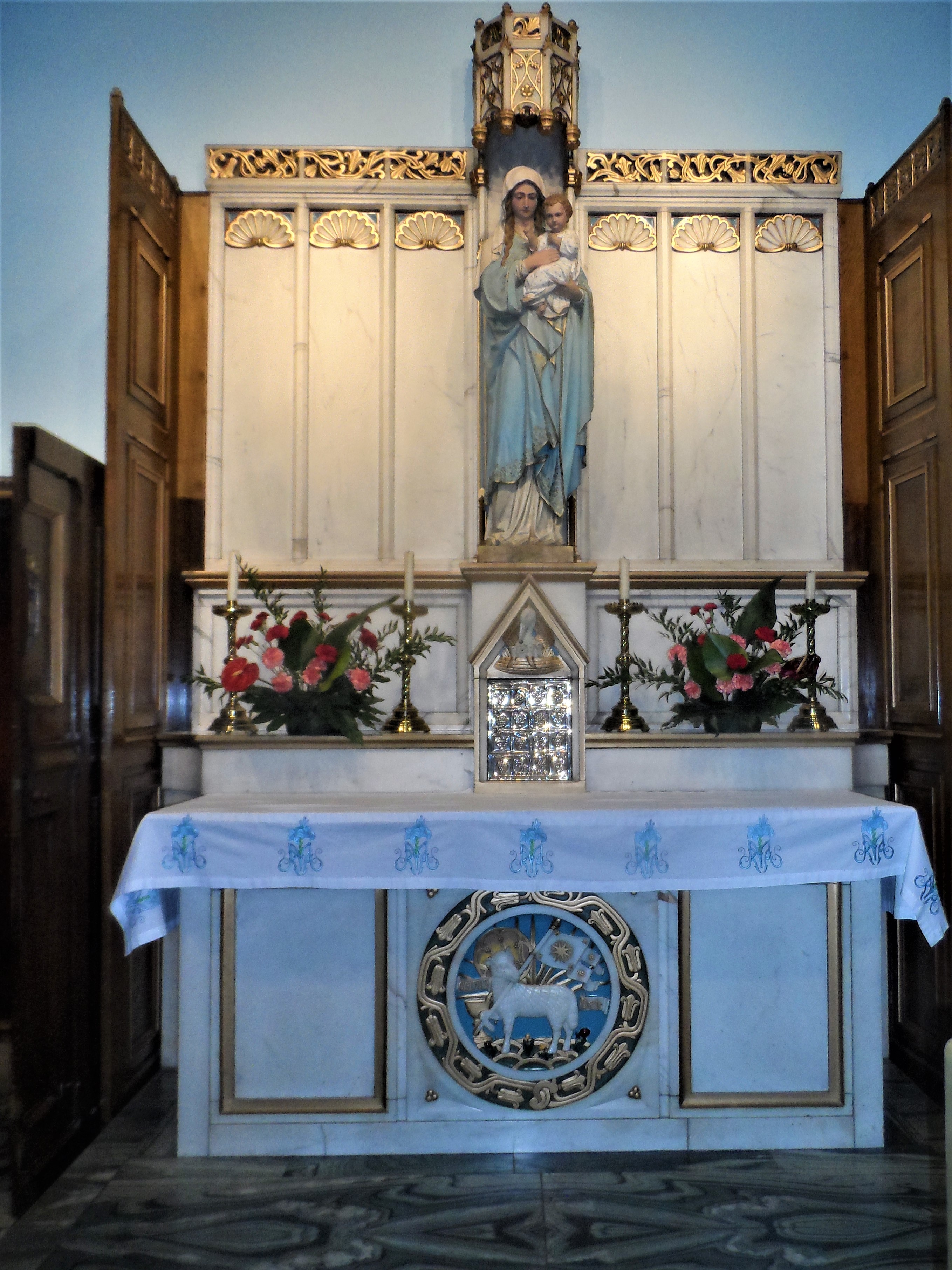
1. Description

La cathédrale abrite le sanctuaire national Saint-André consacré au premier apôtre André, comportant deux de ses reliques, l'une provenant de la cathédrale Saint-André d'Amalfi en Italie et l'autre offerte par le pape Paul VI. Le 23 juillet 1727, l'Écosse est divisée en deux vicariats apostoliques, le district des Lowlands et celui des Highlands. Le district des Lowlands comprenait approximativement les Lowlands écossais. L'évêque Hay, vicaire du district des Lowlands, choisit le site de la chapelle Sainte-Marie en 1801. Celle-ci ouvre ses portes en 1814, conçue par James Gillespie Graham. L'église est considérablement embellie ensuite, et en 1878 avec le rétablissement du clergé écossais, elle est devenue la pro-cathédrale de l'archidiocèse. Elle est baptisée « cathédrale métropolitaine », le 5 juillet 1886 avec tous les droits et privilèges d'une telle église. La cathédrale est agrandie, reconstruite et réaménagée plusieurs fois, le dernier changement structurel important eut lieu dans les années 1970. Le pape Jean-Paul II visite la cathédrale Sainte-Marie en mai 1982 dans le cadre de sa visite pastorale en Écosse.

1. Notes et références


1. Liens externes

Site officiel

(en) St Mary's Episcopal Cathedral, Edinburgh, cathedral.net

Portail de l’Écosse Portail de l’architecture chrétienne Portail du catholicisme Portail des monuments classés au Royaume-Uni

Lieux à Proximité Voir Menu
Location Image
0 m

St Mary's Cathedral, Edinburgh (Catholic)

The Metropolitan Cathedral of Our Lady of the Assumption, also known as St Mary's Metropolitan Cathedral, is a Roman Catholic church in Edinburgh, Scotland. It is the seat of the Archbishop of Saint Andrews and Edinburgh and the mother church of Scots Catholicism. The cathedral church is located at the East End of New Town in the city center.
Location Image
94 m

St Paul's and St George's Church

St Paul's and St George's Church (known colloquially as "Ps and Gs") is an evangelical church of the Scottish Episcopal Church in central Edinburgh, Scotland. It is located on the corner of Broughton Street and York Place in the east end of Edinburgh's New Town, and is protected as a category A listed building. The building was erected as St Paul's Church, replacing a chapel in the Cowgate. It was designed by Archibald Elliot between 1816 and 1818, and was extended by Peddie and Kinnear in the 1890s. In 1932 the congregation merged with that of St George's Church, also located on York Place. The east window is by Francis Eginton of Birmingham. In 2008 a £5.6 million building project to improve facilities in the church was completed.
Location Image
148 m

Lady Glenorchy's Church

Lady Glenorchy's Church or Chapel in Edinburgh was a church founded in the 18th century by Willielma Campbell, Viscountess Glenorchy. It was made a quoad sacra parish in 1837. Most of the church building was demolished in the late 20th century, with the facade forming the frontage of the Glasshouse Hotel on the site.
Location Image
150 m

Edinburgh Assay Office

The Edinburgh Assay Office is the last remaining assay office in Scotland and one of four which remain in the United Kingdom. The Edinburgh Assay Office traces its hallmarking history back to the Gold and Silver Work Act 1457 (c. 8 (S)) the first hallmarking act for Scotland. It is an independent privately run business, owned by the Incorporation of Goldsmiths of the City of Edinburgh. Since 1457, the deacon, or leader of the craft, assayed and marked the members' wares. However, in 1681, a dedicated Assay Master, John Borthwick, was appointed to oversee this task. The incorporation's importance in the life of the city and country was confirmed in 1687 when King James VII granted it a royal charter. The Edinburgh Assay Office is housed in a category B listed building, Goldsmiths Hall in the Broughton Street. It is a former church, built in 1816, which was fully refurbished and opened as the assay office in 1999 by Princess Anne. The assay office primarily tests and hallmarks precious metal. The Hallmarking Act 1973 was passed, then in 2010 palladium became the fourth precious metal to be assayed.
Location Image
151 m

St Oran's Church

St Oran's Church was a Gaelic-speaking congregation of the Church of Scotland in Edinburgh. Originating in the early 18th-century, the congregation continued until 1948, latterly meeting at Broughton Street. Gaelic public worship in Edinburgh began in the early 18th century and culminated with the opening of the first Gaelic Chapel at Castle Wynd near the Grassmarket in 1769. This was the first Gaelic-speaking congregation in the Scottish Lowlands. A second, larger chapel opened at Horse Wynd in 1813 and the two congregations united in 1815, following which the Castle Wynd building was sold. In 1835, the chapel was raised to the status of a parish quoad sacra. The Disruption of 1843 saw all the church's office holders and almost all of its congregation depart the established church to join the Free Church, creating another Gaelic-speaking congregation in Edinburgh: the Gaelic Free Church. Civic improvements in the Old Town forced the congregation to vacate Horse Wynd in 1870. It settled in the former Catholic Apostolic Church on Broughton Street in 1875. In 1900, the congregation adopted the name "St Oran's". The former Gaelic Free Church – by then known as "St Columba's" – had rejoined the Church of Scotland in 1929 due to denominational unions. The General Assembly concluded the maintenance of two small Gaelic-speaking congregations in Edinburgh was unnecessary and, in 1948, St Oran's and St Columba's united to form the Highland Church, using the St Columba's buildings. Greyfriars Kirk maintains St Oran's tradition of Gaelic worship in Edinburghto the present. The first Gaelic Chapel was a simple T-plan building with seats for 800. It was demolished in the 1830s. The Horse Wynd building stood on a rectangular plan and was executed in a plain neoclassical style. It was swept away in the public improvements that created Chambers Street. The Broughton Street building – the only building occupied by the Gaelic congregation that still stands – is a neoclassical, temple-like building of 1843–1844, attributed to John Dick Peddie. It is now in commercial use.