

 English
 Français

Bransdale
Bransdale est une paroisse civile du Yorkshire du Nord, en Angleterre.
1. Histoire


1. Géographie


1. Notes et références


1. Liens externes
Portail de l’Angleterre
Nearby Places View Menu

6.1 km
Sleightholme Dale
Sleightholme Dale, sometimes spelt in one word, Sleightholmedale, is a valley in the North York Moors in North Yorkshire, England. The dale is the middle section of the valley of Hodge Beck (a tributary of the River Dove), below Bransdale and above Kirkdale.
28.7 hectares (71 acres) of the dale is designated a Site of Special Scientific Interest, notified in 1987. The site includes woodland and fen, and includes a heronry, one of the largest in North Yorkshire.
6.5 km
Duck House, Farndale East
Duck House is a historic building in Farndale East, a civil parish in North Yorkshire, in England.
The house was built in about 1520, probably by the mason named either John, or Thomas, Duck. The Duck family lived in the property until 1750, making only limited alterations. It was extended and altered in the 19th century, and then in 1957 it was modernised, the roof was partly raised, and the thatch roof was replaced with shingles. Despite the changes, it remains one of the best-preserved North Yorkshire Moors farmhouses of its period, and it was grade II* listed in 1987.
Originally a longhouse, the low end converted for domestic use, it is partly cruck-framed and encased in limestone, and has a roof of cedar shingle. The high end has a single storey and an attic, and three bays, and the low end to the right has two storeys and three bays. The doorway has a chamfered surround, and a shallow Tudor arched head. In the high end is a two-light mullioned window and a fire window, elsewhere are casement windows, and dormers in the attic. Inside the attic are two pairs of full crucks, and in the ground floor is an inglenook fireplace.

6.6 km
Urra Moor
Urra Moor is the highest moor in the North York Moors, North Yorkshire, England. At 1,490 feet (454 m) above sea level it is the highest point in the former Hambleton District and the North York Moors National Park, and the fourteenth most prominent hill in England. The name is a mix of Old English and Old Norse (horh and haugr) which means The Dirty Hill. The name of Urra Moor applies to the moor as a whole; the summit itself is known as Round Hill.
The summit is crowned by a trig point, and a track passes about 110 yards (100 m) to the south of this point. This track forms part of the route of both the Lyke Wake Walk and the Cleveland Way, and also forms the most commonly used route of ascent for Urra Moor. It is 1.9 miles (3 km) from the car park at Clay Bank to the summit via this route; total ascent is just under 660 feet (200 m).
Urra Moor is noted for its prehistoric remains. There are a number of barrows, and several carved rocks, including some cup and ring carvings. Probably the most striking relic is the Face Stone, a carved stone about 3 feet 3 inches (1 m) in height into which has been carved the shape of a face.

7.3 km
Nawton Tower
Nawton Tower is a country house in Nawton, North Yorkshire, a village in England.
The house was designed by Robert Richardson Banks and Charles Barry Jr. in the Gothic Revival style and completed in 1855. As originally built, it was a tall house with castellation. In 1930, it was heavily altered, reducing its height and removing the Gothic elements, to give it a neoclassical appearance. The tower's gardens retain several 18th-century features, including a portico and two temples which are all grade II listed, terrace and statues. There are formal walks and woodland including azaleas and rhododendrons.
The Doric Temple is a garden pavilion in sandstone with a semicircular plan. Shallow steps lead up to a Doric portico, distyle in antis, with a plain segmental pediment, and a hemispherical roof. Inside, there is hexagonal stone paving.
The Ionic Temple is built of limestone with a pantile roof and a rectangular plan. A flight of narrow steps leads up to an Ionic tetrastyle portico. This has piers with shaped imposts, and a richly carved pediment with a cartouche in voussoirs.
The Garden Portico is also built of limestone. It has a porch with two Ionic columns, a pulvinated frieze, a modillion cornice and a pediment. The door has panels of eight raised lozenges in octagonal surrounds in a plain doorframe.
7.4 km
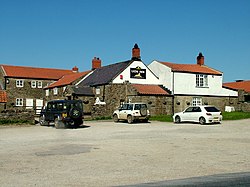
Lion Inn
The Lion Inn is a public house at Blakey Ridge, near Kirkbymoorside, in North Yorkshire, England. The building was completed between 1553 and 1558 (dates vary), and has been used as an inn for four centuries, sitting adjacent to a road across the moors between Castleton and Hutton-le-Hole. During the ironstone industry boom in Rosedale, it catered mainly for those engaged in the mining industry. The inn is known for being subjected to extremes of weather, like Tan Hill Inn, also in North Yorkshire.
At 1,325 ft (404 m) above sea level, it is often referred to as the fourth highest pub in England, and the second highest in Yorkshire (after Tan Hill).