Le Lothian (Lowden en Scots, Lodainn en écossais, anciennement francisé en Lothien ou Lothiane) est une région traditionnelle d'Écosse, s'étendant entre la rive sud du Firth of Forth et les Lammermuir Hills (en). Selon une légende populaire, son nom proviendrait du semi-légendaire roi breton Loth ou Lot.

1. Histoire

Au VIIe siècle, il devient la partie nord du royaume saxon de Northumbrie. Mais au VIIIe siècle les clans pictes la revendiquèrent en profitant de l'affaiblissement de la Northumbrie. Le Lothian est connu en Écosse pour avoir été la seule partie Anglo-Saxonne de cette nation, et une des rares où l'écossais n'ait pas pris racine. À travers le temps, et en raison de plusieurs facteurs, la langue des Lothiens et de l'ancien royaume de Northumbria, le pré-scottis (en) (Inglis) (qui est devenu le Scots moderne) est venue remplacer l'écossais comme langue des Lowlands et s'est attribué le nom de Scots ou Scottis qui désignait avant l'écossais — qui s'est donc retrouvée avec le nom péjoratif d'Erse ou Irish. Au fil de l'histoire de l'Écosse, ce territoire fut divisé entre les comtés de West Lothian, Midlothian et East Lothian - conduisant à l'expression "les Lothians".

1. Actualité

Du 15 mai 1975 au 31 mars 1996, le Lothian réémergea en tant que région d'Écosse selon le découpage administratif alors en vigueur. Son siège était à Édimbourg et elle comprenait les 4 districts suivants :

Le 31 mars 1996, les régions furent remplacées par les council areas dans le nouveau découpage administratif. Le Lothian fut alors partagé en 4 council areas correspondant aux 4 districts : West Lothian, City of Edinburgh, Midlothian et East Lothian.

1. Liens externes

Portail de l’Écosse

Nearby Places View Menu
Location Image
0 m

Lothian

Lothian (; Scots: Lowden, Loudan, -en, -o(u)n; Scottish Gaelic: Lodainn [ˈl̪ˠot̪aɲ]) is a region of the Scottish Lowlands, lying between the southern shore of the Firth of Forth and the Lammermuir Hills and the Moorfoot Hills. The principal settlement is the Scottish capital, Edinburgh, while other significant towns include Livingston, Linlithgow, Bathgate, Queensferry, Dalkeith, Bonnyrigg, Penicuik, Musselburgh, Prestonpans, Tranent, North Berwick, Dunbar and Haddington. Historically, the term Lothian referred to a province encompassing most of what is now southeastern Scotland. In the 7th century it came under the control of the Anglian kingdom of Bernicia, the northern part of the later kingdom of Northumbria, but the Angles' grip on Lothian was weakened following the Battle of Nechtansmere in which they were defeated by the Picts. Subsequent Scottish history saw the region subdivided into three counties—Midlothian, East Lothian, and West Lothian—leading to the popular designation of "the Lothians".
Location Image
712 m

Millerhill railway station

Millerhill railway station served the village of Millerhill, Scotland, from 1847 to 1965 on the Waverley Route.
731 m

Shawfair

Shawfair is a 21st century development, primarily residential in character, under construction in Midlothian, Scotland, near to the existing village of Danderhall and the hamlets of Newton and Millerhill, which lie just outside the eastern boundary of the city of Edinburgh. It is to be built on the site of the former Monktonhall Colliery. The name is derived from a local farm steading of the same name.
Location Image
1.0 km

Shawfair railway station

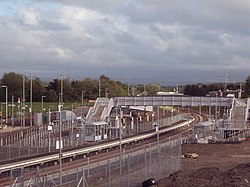
Shawfair is a railway station on the Borders Railway, which runs between Edinburgh Waverley and Tweedbank. The station, situated 5 miles 64 chains (9.33 kilometres) southeast of Edinburgh Waverley, serves the villages of Danderhall and Shawfair in Midlothian, Scotland. It is owned by Network Rail and managed by ScotRail.
Location Image
1.2 km

Sheriffhall railway station

Sheriffhall railway station served the village of Sheriffhall, Dalkeith, Scotland, from 1844 to 1849 on the Waverley Route.