

 English
 Français

Claife Heights
Claife Heights is an upland area in the Lake District, near to Windermere in Cumbria, England. It has a topographic prominence of 177 metres (581 ft) so is classified as a Marilyn (a hill with prominence of at least 150m). It is the subject of a chapter of Wainwright's book The Outlying Fells of Lakeland. He describes a clockwise circuit starting at Far Sawrey and passing Moss Eccles Tarn. He says "Claife Heights is delightful. It was more so before forestry curtailed walking and restricted the views." and describes it as "No definite summit. Highest parts about 900ft."
Nearby Places View Menu

564 m
Claife
Claife is a civil parish in the Westmorland and Furness Unitary Authority of Cumbria, England. It is situated west of Windermere, and east of Esthwaite Water and the village of Hawkshead. In the 2001 census the parish had a population of 392, reducing to 298 at the 2011 census. Settlements in the parish include two villages, Near and Far Sawrey in the south; and the hamlets of High Wray, Low Wray, Colthouse and Loanthwaite in the north.
In the central area of the parish is Claife Heights, a hilly area which rises to 800 feet (240 m) above sea level at Latterbarrow and contains several tarns. There is one major road in the parish, the B5285 connecting Hawkshead to the Windermere Ferry terminus at Far Sawrey.
At Low Wray is Wray Castle, a 19th-century house and grounds now owned by the National Trust. Many of the woodlands in the parish, including the area alongside Windermere are part of the National Trust's Hawkshead and Claife property.
1.2 km
Moss Eccles Tarn
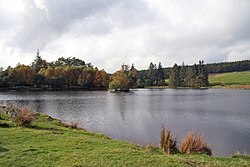
Moss Eccles Tarn is a tarn on Claife Heights, near Near Sawrey in the Lake District, Cumbria. It is currently owned by the National Trust and known as an attractive tarn for fishing and walking. It is known for its association with Beatrix Potter – she owned the tarn and donated it to the National Trust after her death, and it served as inspiration for some of her stories.

1.3 km
Belle Isle (Windermere)
Belle Isle is the largest of 18 islands on Windermere, a mere in the English Lake District, and the only one ever to have been inhabited. It is 1 km in length.
It is rumoured that in Roman times a villa was once built on the island, with a possible connection to the Roman fort at Ambleside. In 1250 it was the seat of the district's Lord of the Manor. It was also a Royalist stronghold during the English Civil War.
Island House was built in 1774 to designs by John Plaw. It is unusual in that it is circular in plan, built of brick, three floors high with a four column portico; it draws closely on the Pantheon, Rome. The house was sold along with the island to the wealthy Curwen family who renamed the island after their daughter, Isabella. It was then sold on to Isabella Curwen by her family in 1781 for £1,720 and was permanently renamed after her. The descendants of Isabella and her husband John Christian Curwen lived on the island until 1993.
It is called 'Bell Island' not 'Isabella Island' because of use of the shortened form of Isabella- Bella, which lost the 'a' to become 'Bell', spelt 'Belle' by the Ordnance Survey map of 1925 over the years. It was known locally as the Great Island or Long Holme and formerly known as Longholm, before its renaming in 1774.
In 1996 (some records suggest 23 December 1994), Belle Isle House suffered serious damage following a large fire. However, it was repaired and is once again a place of residence.

1.5 km
Windermere
Windermere (historically Winder Mere) is a ribbon lake in Cumbria, England. It is within the Lake District and is the largest lake in England by length, area, and volume, although considerably smaller than the largest Scottish lochs and Northern Irish loughs.
Windermere is about 11 miles (18 km) in length and 1 mile (1.6 km) at its widest, has a maximum depth of 64 metres (210 ft), and has an elevation of 39 metres (128 ft) above sea level. Its outflow is the River Leven, which drains into Morecambe Bay. For administrative purposes the lake is in the unitary authority area of Westmorland and Furness, and it historically formed part of the boundary between Westmorland and Lancashire.
The lake has been popular with tourists since the Kendal and Windermere Railway's branch line opened in 1847. The Freshwater Biological Association was established on the shore of Windermere in 1929 and much of the early work on lake ecology, freshwater biology and limnology was conducted here.