

 English
 Français

Branklyn Garden
Branklyn Garden is a hillside public garden in the Kinnoull area of the Scottish city of Perth. The garden is set in 2 acres (0.81 ha) in the western foothills of Kinnoull Hill. A National Trust for Scotland site, the garden was established in 1922 by John and Dorothy Renton, who built a house on the property. The couple's desire was to have a garden that featured rare and unusual plants, along with flowers from all over the world. Several people, including George Forrest and Frank Ludlow, collected seeds for the garden, which now has over 3,500 species of plants. Today, the garden is also home to several national collections of plants, including Meconopsis and Cassiope.
Nearby Places View Menu

173 m
Barnhill railway station, Perth
Barnhill railway station served the suburb of Barnhill, Perth and Kinross, Scotland, from 1847 to 1849 by the Dundee and Perth Railway.
310 m
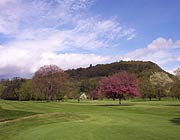
King James VI Golf Club
King James VI Golf Club, located in Perth, Scotland, is a private golf course also open to visitors. The River Tay setting is notable as it is the country's only self-contained course on a river island. The Island course is only accessible by foot by a side-walk on the side of a train bridge crossing the River Tay.
Founded in 1858 nearby at Perth's North Inch, then relocated to Moncreiffe Island in 1897, and a purpose-built course designed by 'Old' Tom Morris, the legendary winner of multiple British Open Championships.
The club is currently captained by Roger Gordon, with Allan Knox the resident professional.

514 m
Tay Viaduct
The Tay Viaduct, also known as the West Railway Bridge, is a single-track railway viaduct in Perth, Perth and Kinross, Scotland. It is around 440 m (1,440 ft) long. It carries the Scottish Central Railway, via a pronounced curve, across the River Tay to and from Perth railway station, 0.5 mi (800 m) to the west. Built in 1864, the work of London's Francis Freeman & Lee, it replaced an earlier double-track timber viaduct dating from 1849. The first pier of today's structure is for a double track, but the line is now single.
The viaduct has seven iron girder spans on the city side of the river, ten stone arches on Moncreiffe Island, and six iron girder spans to the east of Moncreiffe Island. The earlier bridge had 25 arches and an iron swing bridge.
The bridge has two spans across the Tay from Perth: the first is to Moncreiffe Island; the second is from Moncreiffe Island to Barnhill on the river's eastern banks.
It has a pedestrian walkway on the outer edge of its curve. The curve is less severe than its predecessor's was. The current structure has seventeen chains.
650 m
Perth Water Works
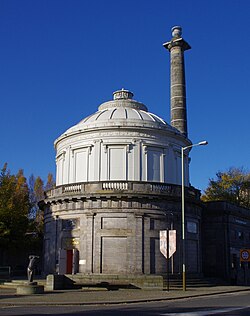
Perth Water Works (also known as Corporation Water Works) is an historic building in Perth, Scotland, dating to 1832. Standing at the corner of Tay Street and Marshall Place (both part of the A989), the building is a former engine house, water tank and art gallery. It was the home of The Fergusson Gallery, displaying the work of John Duncan Fergusson, since 1992. The collection has now been relocated to Perth Art Gallery, though a sculpture remains outside.
The building is Category A listed. Historic Environment Scotland states that it is one of Scotland's most significant industrial buildings, and that its large-scale cast-iron construction may be the first very first in the world.
Clean water was drawn from filter beds on Moncreiffe Island, in the adjacent River Tay, and pumped beneath the river, by a steam engine, into a 146,000 imperial gallons (660,000 L; 175,000 US gal) holding tank in the building's rotunda.
The building's architect was Adam Anderson, the rector of Perth Academy.
An inscription over the door in the rotunda reads Aquam Igne Et Aqua Haurio ("I draw water by fire and water").
The engine house has a tall Doric columned chimney, capped by a Roman urn (a fibreglass replica of the original, which was destroyed by a lightning strike in 1871).
The building became surplus to requirements in 1965, when the city opened a new water works. It was restored in 1973, for use as a Tourist Information Centre, by James Morris and Robert Steedman, and then converted to its current use nineteen years later. Its dome was reconstructed in 2003 as part of a restoration funded by the Heritage Lottery, Historic Scotland and Perth and Kinross Council.