

 English
 Français

Burton-cum-Walden
Burton-cum-Walden est une paroisse civile du Yorkshire du Nord, en Angleterre.
Nearby Places View Menu

1.8 km
Newbiggin, south Wensleydale
Newbiggin is a village and civil parish in Bishopdale, a side dale on the south side of Wensleydale, in the Yorkshire Dales in North Yorkshire, England. The population was estimated at 80 in 2012.
The name Newbiggin derived from the words 'niwe', which is Old English for 'new' and 'bigging', a word from Middle English, said to mean 'building'. This translates to New Building in today's language.
2.4 km
Burton-cum-Walden
Burton-cum-Walden is a civil parish in North Yorkshire, England, in the Yorkshire Dales National Park. It had a population of 303 according to the 2011 census.
From 1974 to 2023 it was part of the district of Richmondshire, it is now administered by the unitary North Yorkshire Council.
The parish boundary is defined by the slopes of the Walden Beck valley (sometimes known as Waldendale). The western boundary runs from the outskirts of Aysgarth over Naughtberry Hill to Buckden Pike. The eastern boundary runs from the A684 over the top of Penhill and Harland Hill towards Buckden Pike. The parish includes the village of West Burton and the hamlets of Walden and Walden Head.

2.7 km
Thoralby
Thoralby is a village and civil parish in the county of North Yorkshire, England. It lies south of Aysgarth, is within a mile of both Newbiggin and West Burton and is in the Yorkshire Dales National Park. It is 23.5 miles (37.8 km) south-west of the county town of Northallerton.

2.8 km
Smelter Farmhouse
Smelter Farmhouse is a historic building in Bishopdale, North Yorkshire, a valley in England.
Smelter is the second farm from the top of Bishopdale. The farmhouse is dated 1701, and was probably built for John Horner. A Mediaeval hearth has been found on the hillside nearby, and the building's name is probably a reference to this. In 1908, it was described as "a quaint-looking structure", and was the house of the local gameskeeper. It was Grade II* listed in 1969, but was uninhabited for a time later in the century.
The farmhouse is in stone with quoins, and a stone slate roof with stone coping and shaped kneelers. There are two storeys and an irregular U-shaped plan, with a front range of three bays, a rear wing on the left, and a shorter staircase wing on the right. The central doorway has an elaborately moulded surround, the inner moulding forming a stepped head with the date and initials on the spandrels. Above is a pulvinated frieze and a segmental pediment. The window over the doorway has a single light with a stepped head, there is an oval fire window, and elsewhere are double-chamfered mullioned windows, some with segmental-arched lights, and some with hood moulds.
2.9 km
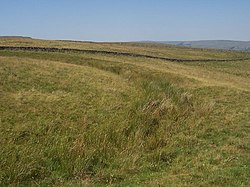
Castle Dykes Henge
Castle Dykes Henge is a Class I Neolithic henge earthwork in the Yorkshire Dales National Park in North Yorkshire, England, situated between the villages of Aysgarth and Thornton Rust. It consists of a roughly circular bank approximately 87 yards (80 m) in diameter with an internal ditch.
It is reported that excavation work took place in 1908, though there is little physical evidence of this as the henge appears to be mostly intact. In 2015 the Royal Archaeological Institute awarded a research grant for a survey of the site and palaeoenvironmental sampling.