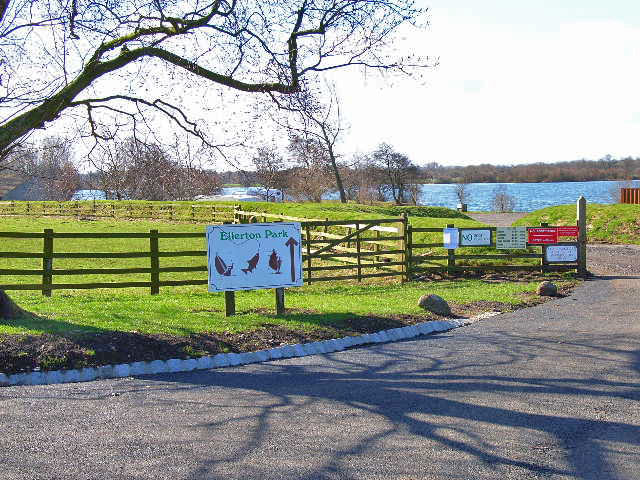
Ellerton-on-Swale or Ellerton (historically known as Ellerton-upon-Swale) is a small village and civil parish about a mile east of Catterick in the county of North Yorkshire, England. In 2015, North Yorkshire County Council estimated the population of the parish at 110. From 1974 to 2023 it was part of the district of Richmondshire, it is now administered by the unitary North Yorkshire Council. The village sits just south of the B6271 road between Richmond and Northallerton, and has a large lake used for diving between the settlement and the River Swale to the south. Another lake to the west, Bolton-on-Swale Lake, is a former sand and gravel quarry and is now a Yorkshire Wildlife Trust sponsored nature reserve. The name Ellerton derives from the Old Norse elri, or the Old English alor, meaning 'alder tree' and the Old English tūn meaning 'settlement'. The village has an entry in the Domesday Book which states that it belonged to Count Alan and had six villagers. It is said that it is the birthplace of Henry Jenkins, who died in 1670 and is reported to have lived to an incredible age of 169 years. In 1743, a memorial obelisk was placed over his grave in the nearby churchyard of Bolton-on-Swale.

Lieux à Proximité Voir Menu
Location Image
0 m

Ellerton-on-Swale

Ellerton-on-Swale est un village et une paroisse civile du Yorkshire du Nord, en Angleterre.
Location Image
1.1 km

Catterick

Catterick est un village et une paroisse civile du Yorkshire du Nord, en Angleterre. Administrativement, il dépend du district de Richmondshire. Au moment du recensement de 2011, il comptait 3 155 habitants. La ville héberge une garnison militaire.
Location Image
1.3 km

Bolton-on-Swale

Bolton-on-Swale est un village et une paroisse civile du Yorkshire du Nord, en Angleterre.
1.4 km

Bataille de Catraeth

La bataille de Catraeth est un affrontement qui aurait eu lieu vers le début du VIIe siècle entre les Bretons du royaume de Gododdin et les Angles de Bernicie ou du Deira. Un groupe de 300 guerriers bretons provenant de tout le Hen Ogledd aurait été réuni par le roi Mynyddog Mwynfawr à Din Eidyn (Édimbourg), la capitale du Gododdin. Ils auraient chevauché vers le sud pour attaquer la forteresse de Catraeth (Catterick, dans le Yorkshire ?), mais ils auraient subi une défaite écrasante face aux Angles. Seuls quelques-uns en auraient réchappé, parmi lesquels le héros Cynon ap Clydno (en) et le poète Aneirin. Cette bataille n'est quasiment connue qu'à travers le poème gallois Y Gododdin, une série d'élégies pour les guerriers du Gododdin tués au combat attribué à Aneirin. Le nom de Catraeth est également mentionné dans deux autres poèmes gallois, le Gweith Gwen Ystrat et le Moliant Cadwallon (cy). Le Y Gododdin, qui est celui qui offre le plus d'informations, est difficile à dater et à interpréter. La « bataille de Catraeth » a été postulée par le philologue gallois Ifor Williams dans son édition du poème en 1938. Longtemps acceptée par la communauté scientifique, sa théorie est cependant remise en question par des lectures plus récentes. Dans un article de 1910, Edward Nicholson (en) propose une interprétation du nom Catraeth en cath Raith, « la bataille de Raith ». Cela situerait selon lui la bataille à Raith (en), dans la région du Fife.
Location Image
1.5 km

RAF Catterick

Royal Air Force Catterick ou RAF Catterick est un ancien aérodrome de la Royal Air Force situé près de Catterick en Angleterre. La station a fermé en 1994 et a été transférée à l'armée de terre britannique pour devenir Marne Barracks. Sur le plan opérationnel, elle est sous le commandement de la garnison de Catterick. La base abrite actuellement le 5th Regiment Royal Artillery (en) et le 32 Engineer Regiment (en).