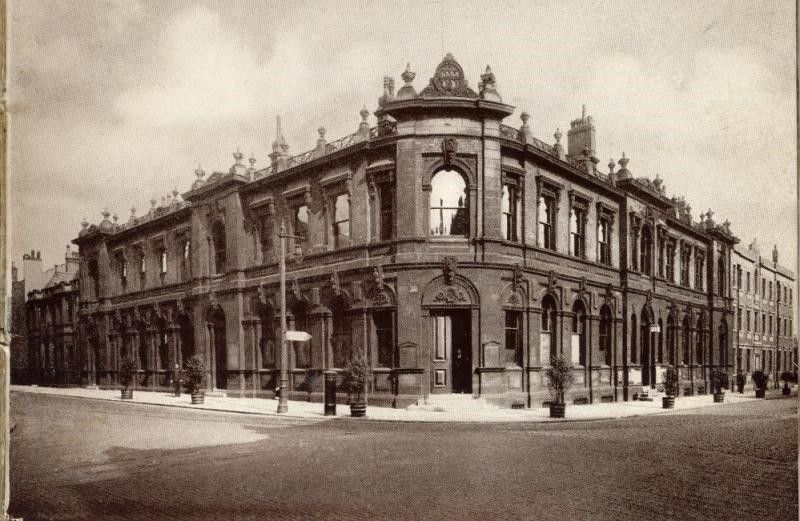
The Old Town Hall was a former municipal facility at the corner of King Street and Rodney Street in Wigan, England. The building, which was demolished in September 2013, had been designated a Grade II listed building in 1990.

1. History

The first town hall in Wigan, located at the western side of the Market Place, was commissioned by the James Barry, 4th Earl of Barrymore and Sir Robert Bradshaigh, the town's representatives in parliament. It was designed in the neoclassical style with arcading on the ground floor to allow markets to be held and completed in 1720. The older building remained in use until its demolition in 1882. The building now referred to as the "old town hall" was the second of three seats of local government in Wigan; it was built on a plot at the corner of King Street and Rodney Street in Wigan, between 1866 and 1867. Designed by local architects Nuttall & Cook, the two-storey Italianate style structure was built largely of brick in Flemish bond, except for its sandstone ashlar ground floor and some sandstone dressings; the roof was of slate. It cost £12,000 to build, the equivalent of about £1.45 million in 2023. The design included large round-headed windows with pilasters between them on the ground floor and square-headed sashed windows with architraves on the first floor; there was a cast-iron parapet above that decorated with urns on pedestals. The new building was originally used as the borough courts until civic leaders move their offices into the building in 1882. King George VI and Queen Elizabeth visited the town hall on 20 May 1938 just before the start of the Second World War. In order to meet the expanding accommodation needs of County Borough of Wigan, some departments moved into a new civic centre which was opened by the Leader of the council, Alderman Ernest Ball, on 22 April 1970. The old town hall continued to be the headquarters of the council until the county borough was abolished by the Local Government Act 1972 in 1974. It then served as the headquarters of the Wigan Metropolitan Borough Council until 1990, when the council moved its staff to the new Town Hall, formerly the home of the Wigan Mining and Technical College. The old Town Hall subsequently remained vacant, and fell into a state of disrepair. Part of the rear of the building was demolished, leaving the remainder insecure. A planning application to redevelop the site as office accommodation and 133 residential units was submitted in 2007. After this proposal did not proceed, the building was completely demolished in September 2013.

1. See also

Listed buildings in Wigan

1. References


1. = Notes =


1. = Citations =


1. = Bibliography =
Lieux à Proximité Voir Menu
166 m

Wigan

Wigan est une ville anglaise chef lieu du district métropolitain du même nom faisant partie du Grand Manchester (Greater Manchester). Elle se trouve près de la rivière Douglas, à 21,4 kilomètres (15 miles) au sud de Preston, à 26,6 kilomètres (16,5 miles) au nord-ouest de Manchester et à 28 kilomètres (17,4 miles) au nord-est de Liverpool. Wigan est la plus grande ville du Metropolitan Borough of Wigan. C’est aussi son centre administratif. La ville de Wigan compte une population de 81 203 habitants en 2001. La totalité du borough en compte 305 600. Historiquement, Wigan fait partie du Lancashire. Durant, l’Antiquité, la ville se trouvait sur le territoire des Brigantes, une ancienne tribu celtique qui contrôlait le Nord de l’Angleterre. Les Brigantes furent envahis durant les conquêtes romaines au Ier siècle apr. J.-C. Il est aujourd’hui affirmé que l’emplacement du camp romain de Coccium se trouve sur la ville actuelle de Wigan. La ville s’intègre dans un borough en 1246 en vertu d'une charte du roi Henri III d'Angleterre. À la fin du Moyen Âge, c’était l’un des quatre boroughs dans le Lancastre à posséder les chartes royales ; les autres étant Lancaster, Liverpool et Preston. Durant la révolution industrielle, Wigan fait face à une expansion économique importante et à une rapide augmentation de la population. Quoique la porcelaine et l’horlogerie aient été les principales industries en ville, Wigan est surtout connue pour ses industries et ses mines de charbon. La première mine de charbon est ouverte à Wigan en 1450. Au plus fort de l'exploitation, on compte 1 000 puits à huit kilomètres du centre-ville (5 miles). L’extraction était si intensive que l’un des conseillers municipaux fit cette remarque : « une mine dans l'arrière-cour n’est pas rare à Wigan ». Le charbonnage s’arrêta dans la dernière partie du XXe siècle. En 1974, Wigan devient une partie du Grand Manchester. Wigan Pier (en), un quai sur le canal entre Leeds et Liverpool, est devenu célèbre grâce à l’écrivain George Orwell. Dans son livre, Le Quai de Wigan (The Road to Wigan Pier), Orwell met en lumière les conditions difficiles de vie et de travail de la population locale dans les années 1930. Avec le déclin de l’activité industrielle dans la région, Wigan Pier avec sa collection d’entrepôts et de quais devient un patrimoine local et un quartier culturel. Le DW Stadium accueille deux clubs, le Wigan Warriors Rugby League Football Club et le Wigan Athletic Football Club. Ces deux équipes évoluent en première ligue nationale (the top-flight national league). Ces 25 000 sièges en font l’un des meilleurs stades de la ligue de rugby à XIII dans le pays.
Location Image
178 m

Gare de Wigan North Western

La gare de Wigan North Western est une gare ferroviaire du Royaume-Uni, située sur le territoire de la ville de Wigan.
Location Image
283 m

Gare de Wigan Wallgate

La gare de Wigan Wallgate est une gare ferroviaire du Royaume-Uni, située sur le territoire de la ville de Wigan.
Location Image
1.5 km

District métropolitain de Wigan

Le district métropolitain de Wigan est un district métropolitain du Grand Manchester, dans l'Angleterre du Nord-Ouest. Il est dénommé d'après sa principale ville, Wigan et inclut également les villes de Leigh, Ashton-in-Makerfield, Ince-in-Makerfield, et Hindley. Le district a été formé en 1974 et est la réunion de plusieurs anciennes administrations locales.
Location Image
1.6 km

DW Stadium

Le DW Stadium (anciennement JJB Stadium) est un stade de football et de rugby à XIII situé à Wigan en Angleterre. C'est l'enceinte des clubs de Wigan Athletic FC et des Wigan Warriors.