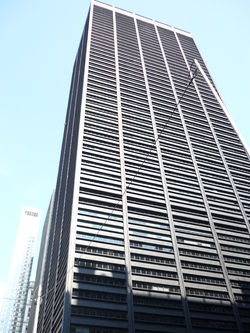
The City Investing Building, also known as the Broadway–Cortlandt Building and the Benenson Building, was an office building and early skyscraper in Manhattan, New York. Serving as the headquarters of the City Investing Company, it was on Cortlandt Street between Church Street and Broadway in the Financial District of Lower Manhattan. The building was designed by Francis Kimball and constructed by the Hedden Construction Company. Because of the area's sloping topography, the City Investing Building rose 32 stories above Broadway and 33 stories above Church Street, excluding an attic. The bulk of the building was 26 stories high above Church Street and was capped by a seven-story central portion with gable roofs. The building had an asymmetrical F-shaped footprint with a light court facing Cortlandt Street, as well as a wing to Broadway that wrapped around a real estate holdout, the Gilsey Building. Inside was a massive lobby stretching between Broadway and Church Street. The upper stories each contained between 5,200 and 19,500 square feet (480 and 1,810 m2) of space on each floor. Work on the City Investing Building started in 1906, and it opened in 1908 with about 12 acres (49,000 m2; 520,000 ft2) of floor area, becoming one of New York City's largest office buildings at the time. Though developed by the City Investing Company, the structure had multiple owners throughout its existence. The City Investing Building was sold to the financier Grigori Benenson (1860–1939) in 1919 and renamed the Benenson Building. After Benenson was unable to pay the mortgage, it was sold twice in the 1930s. The building was renamed 165 Broadway by 1938 and was renovated in 1941. The City Investing Building and the adjacent Singer Building were razed in 1968 to make room for One Liberty Plaza, which had at least twice as much floor area as the two former buildings combined.

Lieux à Proximité Voir Menu
Location Image
5 m

City Investing Building

Le City Investing Building est un gratte-ciel érigé à New York en 1908, et détruit en 1968.
Location Image
27 m

One Liberty Plaza

Le One Liberty Plaza, initialement U.S. Steel Building, est un gratte-ciel situé dans l'arrondissement de Manhattan, à New York. Il compte cinquante-quatre étages et mesure 226 mètres. Construit dans le quartier du World Trade Center, le One Liberty Plaza a été gravement endommagé durant les attentats du 11 septembre 2001 au point que l'on a craint une chute de l'édifice. Le gratte-ciel possède une station de métro dans ses sous-sols et a un temps abrité les quartiers généraux de la société boursière du NASDAQ.
Location Image
49 m

Liberty Street (Manhattan)

Liberty Street est une rue de l'arrondissement de Manhattan à New York.
Location Image
55 m

Parc Zuccotti

Le parc Zuccotti (Zuccotti Park), anciennement connu sous le nom de Liberty Plaza Park, est un parc public et une place situés dans le quartier de Lower Manhattan, dans le sud de l'arrondissement de Manhattan à New York, aux États-Unis. Propriété de Brookfield Office Properties (en), le parc est nommé en l'honneur de John E. Zuccotti (en) après sa rénovation de 2006. Le parc est situé entre les rues Broadway, Trinity Place, Liberty Street (Manhattan) et Cedar Street.
Location Image
55 m

Occupy Wall Street

Occupy Wall Street (OWS) ou Occupy New York (en français : « Occupons Wall Street/New York ») est un mouvement de manifestation de contestation pacifique dénonçant les abus du capitalisme financier. Le mouvement débute le 17 septembre 2011 alors qu'environ 1 000 personnes manifestent dans les environs de Wall Street, le quartier de la bourse à New York. Une partie des manifestants érigent des installations de fortune dans le parc Zuccotti, « occupant » l'endroit dans une sorte de sit-in. Au cours des semaines suivantes, plusieurs centaines de manifestants vivent et dorment dans le parc. Très actif sur les réseaux sociaux, le mouvement s'inspire du printemps arabe, en particulier des révolutions tunisienne et égyptienne, ainsi que du mouvement des Indignés en Espagne. À partir du 9 octobre, le mouvement s'étend à l'ensemble des États-Unis et des manifestations similaires se tiennent dans 70 grandes métropoles avec la participation de 600 communautés. Le 15 octobre, date choisie pour être la première journée mondiale de protestation pour de vraies démocraties, le mouvement Occupy s'étend dans environ 1 500 villes de 82 pays. À la mi-novembre, dans la nuit du 14 au 15, les manifestants sont expulsés du parc par la police de New York, qui y interdit le campement. Malgré la fin de l'occupation, le mouvement poursuit des moyens de pression, notamment par des actions éclair et ciblées[source insuffisante].