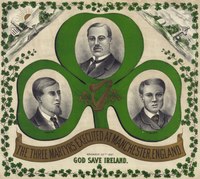
The Manchester Martyrs (Irish: Mairtirígh Mhanchain) were three Irish Republicans – William Philip Allen, Michael Larkin, and Michael O'Brien – who were hanged in 1867 following their conviction of murder after an attack on a police van in Manchester, England, in which a police officer was accidentally shot dead, an incident that was known at the time as the Manchester Outrages. The three men were members of the Irish Republican Brotherhood, also known as the Fenians, an organisation dedicated to ending British rule in Ireland, and were among a group of 30 to 40 Fenians who attacked a horse-drawn police van transporting two arrested leaders of the Brotherhood, Thomas J. Kelly and Timothy Deasy, to Belle Vue Gaol. Police Sergeant Charles Brett, travelling inside with the keys, was shot and killed while looking through the keyhole of the van as the attackers attempted to force the door open by shooting the lock. Kelly and Deasy were released after another prisoner in the van took the keys from Brett's body and passed them to the group outside through a ventilation grill; the pair were never recaptured, despite an extensive search. Although Allen and Larkin admitted taking part in the attack, none of the defendants was accused of firing the fatal shot, but they were convicted on the basis of "joint enterprise" for taking part in a criminal enterprise that ended in the killing. The trial has nonetheless been described by an eminent Irish historian as "unsatisfactory", and the evidence as "dubious". Two others were also charged and found guilty of Brett's murder, Thomas Maguire and Edward O'Meagher Condon, but their death sentences were overturned—O'Meagher Condon's through the intercession of the United States government (he was an American citizen), and Maguire's because the evidence given against him was considered unsatisfactory by the court. Allen, Larkin and O'Brien were publicly hanged on a temporary structure built on the wall of Salford Gaol, on 23 November 1867, in front of a crowd of 8,000–10,000. Ireland reacted with revulsion and anger to the executions, and Allen, Larkin and O'Brien were hailed as political martyrs. Annual commemorations were held throughout Ireland, and monuments were built in many Irish towns. Brett, the first Manchester City Police officer to be killed on duty, is memorialised in a monument in St Ann's Church.

Lieux à Proximité Voir Menu
Location Image
258 m

Hyde Road

Hyde Road est un ancien stade de football établi à West Gorton, Manchester, en Angleterre. Il fut le stade de Manchester City et de ses prédécesseurs depuis sa construction, en 1887, jusqu'en 1923, lorsque le club emménagea à Maine Road.
Location Image
591 m

Chorlton-on-Medlock

Chorlton-on-Medlock est une aire urbaine dans l'agglomération de Manchester, au nord-ouest de l'Angleterre. À l'origine, Chorlton-on-Medlock était situé dans le Lancashire. Cette ancienne ville aujourd'hui incluse dans Manchester est délimitée au nord par la Medlock qui passe juste au sud du centre-ville de Manchester, et sur ses autres côtés par Stockport Road, Hathersage Road, Moss Lane East et Boundary Lane. Les districts voisins sont ceux de Hulme à l'ouest, Ardwick à l'est et Victoria Park, Rusholme et Moss Side au sud. Une grande partie du district, le long de Oxford Road, est occupée par le campus de l'université de Manchester, l'université métropolitaine de Manchester, et le Royal Northern College of Music. Au sud du campus d'Oxford Road se trouve un groupe d'hôpitaux contigus parmi lesquels on trouve le Manchester Royal Infirmary, à l'ouest duquel se trouve Whitworth Park.
Location Image
783 m

Ardwick

Ardwick est un quartier situé 1,5 km au sud du centre-ville de Manchester. Au milieu du XIXe siècle, Ardwick se développe comme un village plaisant de la banlieue de Manchester mais qui s'industrialise fortement à la fin de ce siècle. Quand la plupart de ses industries déclinent, Ardwick fait de même, formant une des zones les plus abandonnées de la ville. Des tentatives de redynamisation du quartier sont entreprises, notamment par la construction d'infrastructures pour les Jeux du Commonwealth de 2002. Des lieux de divertissement présents au XIXe siècle, il ne reste plus aujourd'hui que Manchester Apollo, une salle de concert accueillant des groupes de pop et de rock.
Location Image
857 m

Beswick

Beswick est un quartier de Manchester, au nord ouest de l'Angleterre. Il est traversé par la rivière Medlock et le canal Ashton. Il avoisine le district de plus grande taille de Bradford et on se réfère parfois à ces deux zones comme Bradford-with-Beswick. Comme plusieurs districts du centre et de l'est de Manchester, Beswick est connu pour sa pauvreté, bien qu'il y ait eu des améliorations depuis que les jeux du Commonwealth ont eu lieu dans cette zone en 2002. Portail de Manchester et de son comté
967 m

Belle Vue Gaol

Belle Vue Gaol, également désignée sous les noms de Manchester City Gaol, Manchester Borough Gaol (Prison d'arrondissement de Manchester) ou Gorton Gaol, est une ancienne prison victorienne située à Gorton, Manchester, en Angleterre, ayant fonctionné de 1850 à 1888. Elle était connue à l'époque pour les conditions de vie particulièrement rudes des prisonniers. Elle est démolie en 1892.