

 English
 Français

Battle of Largs
The Battle of Largs (2 October 1263) was a battle between the kingdoms of Norway and Scotland, on the Firth of Clyde near Largs, Scotland. The conflict formed part of the Norwegian expedition against Scotland in 1263, in which Haakon Haakonsson, King of Norway attempted to reassert Norwegian sovereignty over the western seaboard of Scotland. Victory was achieved by the Scots with a crafty three-tiered strategy on the part of the young Scottish king, Alexander III: plodding diplomacy forced the campaign to bad weather months and a ferocious storm ravaged the Norwegian fleet, stripping it of many vessels and supplies and making the forces on the Scottish coast vulnerable to an attack that forced the Norwegians into a hasty retreat that was to end their 500-year history of invasion, and leaving Scotland to consolidate its resources into building the nation. Since the beginning of the 12th century, Largs in the north Ayrshire area of Scotland had lain at the periphery of the Norwegian realm, ruled by magnates who recognised the overlordship of the kings of Norway. In the mid-13th century, two Scottish kings, Alexander II and his son Alexander III, attempted to incorporate the region into their own realm. Following Alexander III's early, failed attempts to purchase the islands from the Norwegian king, the Scots launched military operations to end the issue altogether by asserting royal sovereignty over all of western Scotland. Haakon responded to the Scottish aggression by leading a massive Norwegian fleet, thought to number in the thousands of vessels, that reached the Hebrides in the summer of 1263. Realizing that the Scots were tremendously outnumbered by an experienced and mobile enemy, Alexander III sought a protracted diplomatic intervention that would buy time to acquire more troops and possibly force the Norwegians into the stormy autumn and winter months where an invasion could be stalled due to weather. By late September, Haakon's fleet occupied the Firth of Clyde and the temperate days — such as they are on the western coast of Scotland — were almost at an end. When negotiations between the kingdoms broke down, Haakon brought the bulk of his fleet to anchor off the Cumbraes, poised to invade Scotland at a site of his choosing. On the night of 1 October, during a bout of stormy weather, several Norwegian vessels were driven aground on the Ayrshire coast, near present-day Largs. On 2 October, while the Norwegians were salvaging their vessels, the main Scottish army arrived on the scene. Composed of infantry and cavalry, the Scottish force was commanded by Alexander of Dundonald, Steward of Scotland. The Norwegians were gathered in two groups: the larger main force on the beach and a small contingent atop a nearby mound. The advance of the Scots threatened to divide the Norwegian forces, so the contingent on the mound ran to rejoin their comrades on the beach below. Seeing them running from the mound, the Norwegians on the beach believed they were retreating and fled back towards the ships. There was fierce fighting on the beach, and the Scots took up a position on the mound formerly held by the Norwegians. Late in the day, the Norwegians recaptured the mound after several hours of skirmishing. The Scots withdrew from the scene and the Norwegians reboarded their ships. They returned the next morning to collect their dead. With the weather deteriorating, Haakon's fleet sailed to Orkney to overwinter. The battle is commemorated in Largs by an early 20th-century monument, and festivities held there annually since the 1980s.
Lieux à Proximité Voir Menu

Largs
Bataille de Largs
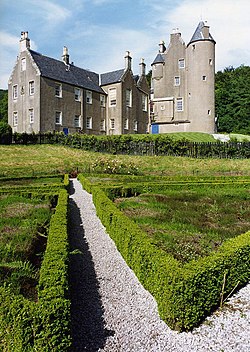
Château de Kelburn

