Location Image

Wall Street station (IRT Lexington Avenue Line)

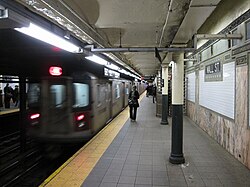
The Wall Street station is a station on the IRT Lexington Avenue Line of the New York City Subway. The station is located at the intersection of Broadway and Wall Street in the Financial District of Lower Manhattan. It is served by the 4 train at all times and the 5 train at all times except late nights. The Wall Street station was constructed for the Interborough Rapid Transit Company (IRT) as part of the city's first subway line, which was approved in 1900. Construction of the tunnel around the Wall Street station was complicated by the shallow foundations of the nearby Trinity Church, as well as the need to avoid disrupting the street surface of Broadway. The station opened on June 12, 1905, as an extension of the original line. The station's platforms were lengthened in the late 1950s, and it was renovated in the 1970s and 2000s. The Wall Street station contains two side platforms and two tracks, and it was built with tile and mosaic decorations. The platforms contain exits to Broadway's intersections with Wall and Rector Streets, outside Trinity Church, and into the basements of several buildings. An additional passageway extends east to an out-of-system connection with the Broad Street station and the basement of 28 Liberty Street. The original station interior is a New York City designated landmark and listed on the National Register of Historic Places.

Lieux à Proximité Voir Menu
Location Image
10 m

Manhattan Life Insurance Building

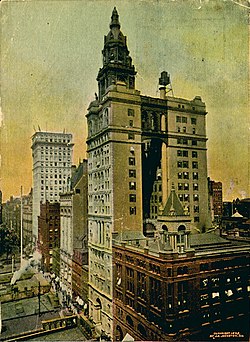
Le Manhattan Life Insurance Building fut construit dans l'arrondissement de Manhattan à New York d'après des plans de Kimball & Thompson et sous la direction de l'ingénieur Charles Sooysmith entre 1893 et 1894. Sa construction fut commandée par la Manhattan Life Insurance Company qui désirait construire un gratte-ciel qui pourrait surpasser ceux des concurrents. Cela explique le fait que le bâtiment culmine à 106 mètres, et comporte 18 étages ; il fut en conséquence le premier gratte-ciel à franchir la barre des 100 mètres, et le plus haut bâtiment de New York entre 1894 et 1899, en dépassant le New York World Building, avant d'être à son tour dépassé par le Park Row Building qui culminait à 119 mètres. Il fut démoli en 1963 ou 1964 - selon les sources. Le Manhattan Life Insurance Building fut en outre l'un des premiers buildings à utiliser un système de ventilation électrique pour le chauffage et la climatisation.
Location Image
30 m

Lower Manhattan

Lower Manhattan, en français : « Bas Manhattan », (appelé aussi Downtown Manhattan), est le quartier le plus au sud de l'île de Manhattan, l'un des cinq arrondissements de la ville de New York, aux États-Unis. Il est généralement délimité par la rue Chambers au nord, North River (une partie du cours de l'Hudson River) à l'ouest, l'East River à l'est, et au sud par Battery Park et la Upper New York Bay. Lower Manhattan, appelé aussi Financial District, inclut Wall Street, l'hôtel de ville, le Municipal Building et le site du One World Trade Center. C'est le quatrième « Central business district » du pays après Midtown (Manhattan), le Loop (Chicago) et Washington. C'était le troisième CBD avant les attentats du 11 septembre 2001.
Location Image
49 m

Wall Street (IRT Lexington Avenue/métro de New York)
Wall Street est une station souterraine du métro de New York située dans le Financial District au sud de Manhattan. Elle est située sur l'une des lignes (au sens de tronçons du réseau) principales, l'IRT Lexington Avenue Line (métros verts) issue du réseau de l'ancienne Interborough Rapid Transit Company (IRT), et faisait partie de la toute première ligne de métro souterraine de Manhattan (Manhattan Main Line). Comme son nom l'indique, elle dessert le quartier d'affaires de Wall Street. Sur la base de la fréquentation, la station, qui porte le même nom que celle située sur la Broadway-Seventh Avenue Line (métros rouges) figurait au 63e rang sur 421 en 2012. Au total, deux services y circulent : les métros 4 y transitent 24/7 ; les métros 5 s'y arrêtent tout le temps sauf la nuit (late nights).
Location Image
55 m

1 Wall Street

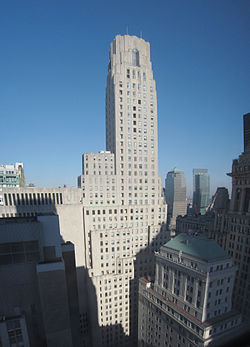
Le One Wall Street, originellement le Irving Trust Company Building, ensuite la Bank of New York Building (après 1988), et après 2007 le BNY Mellon Building, fut terminé en 1931 après deux années de travaux. Les plans d'origine sont de l'architecte américain Ralph T. Walker.
Location Image
56 m

Bank of Tokyo building

Le Bank of Tokyo building fut construit à Manhattan à New York de 1894 à 1896, selon les plans de Bruce Price. Il est situé en face de l'église Trinity. C'est l'un des premiers gratte-ciel de Manhattan avec une ossature en acier, et un modèle innovant de tour autoportante ayant inspiré l'architecture de Manhattan jusque dans les années 1920. Il comportait à l'origine 21 étages et fut le deuxième plus haut édifice de New York.