Ruchazie ( rukh-HAY-zee) is a neighbourhood in the Scottish city of Glasgow. It is situated to the north-east of the city, bordered by Craigend and Garthamlock to the east and the open ground of Hogganfield Park and Lethamhill Golf Course to the north. Ruchazie is separated from Cranhill to the south and Riddrie to the west by the M8 motorway (Junctions 11 and 12 of which directly serve the area), previously the route of the Monkland Canal.

A small hamlet existed in the area from at least the 18th to the mid-20th century near to the Gartcraig Colliery, located where the local housing office now stands. There was also a productive brick works at Gartcraig from the 1870s to the 1920s, and two country house estates, Croftcroighn and Craigend. Developed for housing as part of the city's 'Greater Easterhouse' programme in the 1950s, mostly consisting of tenements, the neighbourhood was at the centre of the Glasgow Ice Cream Wars in the 1980s which culminated in the death of a local family when their flat was set on fire, and also suffered from the habitual territorial gang violence in the area, with rival 'young teams' not only from the surrounding schemes but within the fairly small Ruchazie itself, with a gang from each of its three clusters of streets. The area has experienced considerable regeneration and improvement in the early 21st century through Tower Homes LHO and Ruchazie Housing Association.

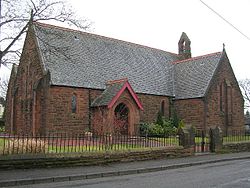
Ruchazie is the only district in Glasgow that does not have a public house. In August 2009, construction of a Soccerworld five-a-sides complex situated on ground between Croftcroighn Road and the M8 motorway (formerly Whitehill Secondary Former Pupils F.C. playing fields) was completed and opened to the public. The facility includes a soft play area, female-only gym and a licensed bar. There were two churches in the area: Ruchazie Parish Community Church and the Roman Catholic St Philip's, which closed in 2014. The local schools had already closed and been merged with others in the early 2000s. Singer Jim Diamond grew up in ruchazie and attended St. Philips RC primary school . In 2016, Glasgow City Council outlined masterplans for the development of the Greater Easterhouse area (including Ruchazie) over the next 20 years.

Lieux à Proximité Voir Menu
Location Image
2.5 km

Stepps

Stepps est une localité britannique située dans le North Lanarkshire, en Écosse.
Location Image
2.7 km

Red Road (appartements)

Les Red Road Flats étaient un ensemble de tours d'habitation du milieu du XXe siècle situé entre les districts de Balornock (en) et de Barmulloch (en), au nord-est de la ville de Glasgow, en Écosse. À l'origine, le lotissement se composait de huit blocs de plusieurs étages à ossature métallique. Tous ont été démolis en 2015. Deux d'entre eux étaient des "dalles", beaucoup plus larges en section transversale qu'elles ne sont profondes. Six étaient des "pointes", qui avaient plutôt la forme d'une tour traditionnelle. Les dalles avaient 28 étages (26 occupables et 2 mécaniques), les blocs de pointe 31 (30 occupables et 1 mécanique), et pris ensemble, ils étaient conçus pour une population de 4 700 personnes. Les blocs ponctuels étaient parmi les plus hauts bâtiments de Glasgow, avec 89 mètres, ce qui les plaçait au deuxième rang en termes de hauteur totale, derrière les anciennes tours Bluevale et Whitevale (en) de Camlachie (en). Le 30e étage des "Point Blocks" était le plus haut niveau habitable de tous les bâtiments de Glasgow. Les vues depuis les étages supérieurs ont attiré l'attention le long des Campsie Fells vers Ben Lomond et les Alpes d'Arrochar (en), puis vers l'ouest après le pont Erskine (en) et vers Goat Fell sur l'île d'Arran, en continuant vers le sud au-dessus de Glasgow et vers l'est en direction d'Edimbourg. Par temps clair, les bâtiments étaient visibles dans le ciel de Glasgow à une distance de 16 kilomètres. Le 31e étage des blocs de pointes et le 28e étage correspondant des dalles étaient réservés à une aire de séchage commune. Parmi les plus connus des tours d'habitation de Glasgow des années 1960, les bâtiments ont été officiellement condamnés en juillet 2008 après une longue période de déclin, leur démolition progressive se déroulant en trois étapes entre 2010 et 2015.
Location Image
2.8 km

Easterhouse

Easterhouse est une banlieue dans l’est de Glasgow. Glasgow est la plus grande ville de l’Écosse, qui se trouve dans l’ouest du pays. Il y a environ 26 000 habitants à Easterhouse. La banlieue a beaucoup grandi, après la Seconde Guerre mondiale, quand la ville de Glasgow a construit beaucoup d’appartements pour la population. Depuis quelques années, on construit des maisons plus modernes.
Location Image
2.8 km

Tollcross International Swimming Centre

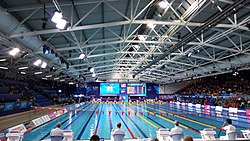
Le Tollcross International Swimming Centre est une piscine olympique et centre de loisirs situé à Tollcross à Glasgow.
Location Image
3.1 km

Parkhead

Parkhead est un quartier de la ville de Glasgow, situé dans le East End (en français : « à l'est »). Son nom vient de celui d'un ancien hameau spécialisé dans le textile. La Great Eastern Road, la Westmuir Street, la Duke Street (en) et la Springfield Road se rencontrent à Parkhead Cross, le carrefour au cœur du quartier. Le quartier donne parfois son nom au Celtic Park, le stade du Celtic Football Club, un des deux principaux clubs d'Écosse.