Location Image

Cessnock subway station

Cessnock subway station is a station on the Glasgow Subway that serves the eastern part of Ibrox and the Cessnock area of the city. It is also the nearest station to Festival Park. Along with Kelvinhall, it is one of only two stations to retain its pre-modernisation surface buildings and entryway. It is also the only station to retain its pre-modernisation livery and signage. The entrance is at the east end of Walmer Crescent and leads under the residential housing. It was opened in 1896 and modernised in 1977–1980. The station retains its original island platform configuration, and has no escalators. In 1989 when work was being carried out to restore an adjoining building designed by Alexander Greek Thomson two metal arches bearing the station's name and in a style echoing that of Greek Thomson were added at street level. The idea was that these would draw attention to the steps down to the station's entrance which is located in the basement of a tenement, just below street level. When they were to be removed in a later renovation of the station, public opposition forced the restoration of one of the arches which had been taken down, and ended plans to remove the other. There are 520,000 boardings per year at this station. The station is located close to the Glasgow Science Centre, BBC Scotland, STV Studios, and the SEC Centre. Ceessnock is one of the stations mentioned in Cliff Hanley's song The Glasgow Underground.

Lieux à Proximité Voir Menu
224 m

Cessnock (Glasgow)

Cessnock est un quartier de la ville de Glasgow, en Écosse. Il est situé au sud du fleuve Clyde et faisait partie de l’ancien bourg de Govan. La rue principale de Cessnock est Paisley Road West, qui s’étend vers l’ouest en direction de Paisley et vers l’est à travers Kinning Park jusqu’à Paisley Toll.
685 m

BBC Radio Scotland

BBC Radio Scotland est une station de radio de langue anglaise du groupe BBC Scotland émettant sur l'ensemble du territoire écossais.
Location Image
686 m

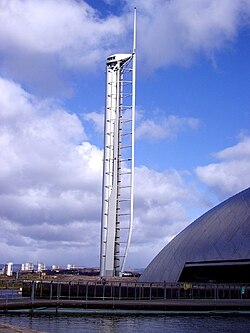
Tour de Glasgow

La Tour de Glasgow (Glasgow Tower) est un édifice high-tech autoportant situé sur la rive sud de la rivière Clyde à Glasgow en Écosse. Elle fait partie du complexe des sciences et techniques de Glasgow (Glasgow science centre) avec le cinéma IMAX, le Science Mall édifiés sur le même site et le parc éolien de Whitelee (Whitelee Wind Farm). La tour avec ses 127 mètres de haut est entrée dans le Livre Guinness des records en étant la plus haute du monde capable de pivoter sur 360 degrés. Elle a été conçue par l'architecte Richard Horden assisté de l'ingénieur en design Buro Happold. Elle possède une plate-forme d'observation à 105 mètres d'altitude.
690 m

Ibrox Park (1887-1899)

Ibrox Park était un terrain de football situé à Glasgow, dans le quartier d'Ibrox, en Écosse. C'était le terrain d'origine des Rangers de 1887 jusqu'à ce qu'ils déménagent dans le deuxième Ibrox Park adjacent en 1899. Le terrain a accueilli quatre fois la finale de la Coupe d'Écosse de football et trois matchs internationaux de l'équipe d'Écosse de football.
Location Image
728 m

Désastre d'Ibrox de 1902

Le désastre d'Ibrox de 1902 est un accident mortel consécutif à l'effondrement d'une tribune à Ibrox le 5 avril 1902.