
Location Image

Cockenzie power station

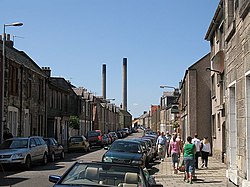
Cockenzie power station was a coal-fired power station in East Lothian, Scotland. It was situated on the south shore of the Firth of Forth, between the town of Prestonpans and the villages of Cockenzie and Port Seton, 8 mi (13 km) east of the Scottish capital of Edinburgh. The station dominated the local coastline with its distinctive twin chimneys from 1967 until the chimneys' demolition in September 2015. Initially operated by the nationalised South of Scotland Electricity Board, it was operated by Scottish Power following the privatisation of the industry in 1991. In 2005 a WWF report named Cockenzie as the UK's least carbon-efficient power station, in terms of carbon dioxide released per unit of energy generated. The 1,200 megawatt power station ceased generating energy on 15 March 2013 around 8.30am. There are plans to replace the station with a combined cycle gas turbine (CCGT) power station. The removal of the power station was done in stages with the twin chimneys and turbine hall being demolished in a controlled explosion on 26 September 2015, the front section of the boiler house on 4 November 2015 and the rest of the boiler house on 17 December 2015. This was the last remaining major structure to be removed.

Lieux à Proximité Voir Menu
Location Image
606 m

Cockenzie and Port Seton

Cockenzie and Port Seton est une ville située dans l'East Lothian, en Écosse. En 2020 la population de Cockenzie and Port Seton est estimée à 5 370 habitants.
Location Image
1.2 km

Prestonpans

Prestonpans (gaélique écossais: Baile an t-Sagairt, scots: The Pans) est une ville écossaise située dans l'East Lothian, située à l'est d'Édimbourg. La ville est célèbre pour avoir été le lieu de la Bataille de Prestonpans en 1745, pour ses peintures murales (elle est même surnommée Scotland's Mural Town) et pour sa tour ancienne (en).
Location Image
1.7 km

Bataille de Prestonpans

La bataille de Prestonpans, également connue sous le nom de bataille de Gladsmuir, est le premier combat significatif de la seconde rébellion jacobite. Elle a lieu à Prestonpans, dans l'East Lothian, en Écosse, le 21 septembre 1745. L'armée jacobite de Jacques François Stuart, commandée par son fils, Charles Édouard Stuart défait l'armée hanovrienne de George II sous les ordres de Sir John Cope. Charles-Edouard a été nommé régent d'Écosse par son père Jacques-Edouard qui avait organisé les deux précédentes rébellions de 1715 et 1719. Charles-Edouard est soutenu par la France qui augmentera peu à peu ses renforts au fur et à mesure de la campagne à la demande de Boyer d'Éguilles, le représentant de Louis XV auprès du jeune "prétendant".
Location Image
2.8 km

Tranent

Tranent est une ville britannique de l’East Lothian, en Écosse. Elle est près de la route A1 et environ à 18 km d’Édimbourg. Elle est l’une des plus anciennes villes de l’East Lothian, et a été construite à environ 90 mètres (300 pieds) au-dessus du niveau de la mer.
Location Image
4.2 km

Wallyford

Wallyford est un village situé dans l’East Lothian, en Écosse.