
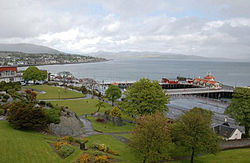
Dunoon (; Scottish Gaelic: Dùn Omhain [t̪un ˈo.ɪɲ]) is the main town on the Cowal peninsula in Argyll and Bute, Scotland. It is located on the western shore of the upper Firth of Clyde, to the south of the Holy Loch and to the north of Innellan. As well as forming part of the council area of Argyll and Bute, Dunoon also has its own community council. It was a burgh until 1976. The early history of Dunoon often revolves around two feuding clans: the Lamonts and the Campbells. The town was a popular destination when travel by steamships was common around the Firth of Clyde; Glaswegians described this as going doon the watter. This diminished, and many holidaymakers started to go elsewhere as roads and railways improved and the popularity of overseas travel increased. In 1961, during the height of the Cold War, Dunoon became a garrison town to the United States Navy. In 1992, shortly after the dissolution of the Soviet Union, they closed their Holy Loch base in Sandbank, and neighbouring Dunoon suffered an economic downturn. Since the base's closure, the town and surrounding area are again turning to tourism, marketing to outdoor enthusiasts and wildlife lovers, as well as promoting festivals and competitions. The largest annual event held in the town is the Cowal Highland Gathering, which has been held since 1894. The Royal National Mòd has also been held in the town.

Lieux à Proximité Voir Menu
Location Image
477 m

Dunoon

Dunoon (Dùn Omhain en gaélique écossais) est une station balnéaire située sur la péninsule de Cowal dans l'Argyll and Bute en Écosse. Elle est située sur le Firth of Clyde à côté du Holy Loch et à l'opposé de Gourock La ville abrite lors du dernier week-end d'août le (en) Cowal Highland Gathering (connu aussi sous le nom de Cowal Games), des jeux annuels des Highlands et plus grande manifestation mondiale de sports écossais. C'est le lieu de naissance de l'acteur écossais Sylvester McCoy, connu pour avoir incarné le Septième Docteur dans la série télévisée britannique Doctor Who.
Location Image
3.0 km

Phare de Cloch Point

Le phare de Cloch Point est un phare édifié sur la côte du Firth of Clyde, entre Inverkip et Gourock face à Dunoon, dans le comté de Argyll and Bute dans le sud-ouest de l'Écosse. Il est maintenant protégé en tant que monument classé du Royaume-Uni de catégorie B. Ce phare est géré par la Clyde Port Authority (en).
Location Image
4.0 km

Holy Loch

Holy Loch est un loch d'Argyll and Bute en Écosse. Il est ouvert sur le Firth of Clyde à l'est et près de la ville de Dunoon.
Location Image
5.4 km

Inverkip

Inverkip (Inbhir Chip en gaélique (gd)) est une ville et une paroisse civile d'Écosse, située dans le council area d'Inverclyde et dans la région de lieutenance du Renfrewshire. Elle est située à 7 kilomètres au sud-ouest de Greenock, à 105 kilomètres d'Édimbourg et 580 kilomètres de Londres. Elle est desservie par l'A78 (en) et par la gare d'Inverkip (en) située sur la ligne d'Inverclyde (en). Sur son territoire se trouve le château d'Inverkip (en) et se trouvait la centrale thermique d'Inverkip (dont la cheminée de 236 mètres constituait le plus haut bâtiment d'Écosse) jusqu'à sa démolition le 28 juillet 2013.
Location Image
6.2 km

Centrale thermique d'Inverkip

La centrale thermique d'Inverkip est une centrale thermique, située à Inverkip, dans le council area d'Inverclyde en Écosse. Elle a arrêté de fonctionner en 1988 et a été démolie à partir de 2010. Sa cheminée, haute de 236 mètres et constituée de 1,4 million de briques, a été détruite le 28 juillet 2013. Elle était le bâtiment écossais le plus élevé.