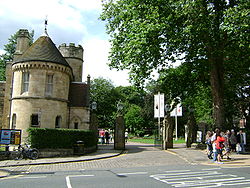
51 Bootham is a historic building on Bootham, a street leading north from the city centre of York in England. The building was designed by Peter Atkinson for Richard Vanden-Bempde-Johnstone and was completed in or shortly after 1804. It was initially known as "Bootham House". In 1846, Bootham School purchased and relocated to the building. The school redesigned the rear wing and extended it. The rearmost part of the building was destroyed in a fire in 1899. In about 1902, it was replaced by a science block (now the John Bright Library) and a gymnasium, designed by Fred Rowntree and W. H. Thorp in the arts and crafts style. In about 1956, the block was altered by Colin Rowntree, work including dividing the gymnasium into classrooms. The building was Grade II* listed in 1954. The front to Bootham is of brick with stone dressings and a slate roof. It is three storeys tall, with attics and a basement, and is five bays wide. There are sash windows, becoming less elaborate with each storey, and three dormer windows in the attic. At first floor level there is an iron balcony running the whole width of the building. The door has a fanlight and a Doric portico. The 1902 extension is built of red brick with terracotta dressings. It has an entrance front facing southeast, the door of which has a doorcase in the Ionic order. This section consists of various wings, each of which is two storeys tall. The library section has bow windows and an octagonal wooden cupola. Inside, the original section has a stone staircase and several original fireplaces, while the 1902 block has panelled classrooms, and a stone staircase with an Art Nouveau balustrade. The library has built-in shelves and a bronze memorial plaque to John Bright.

Lieux à Proximité Voir Menu
Location Image
156 m

York Art Gallery

La York Art Gallery est un musée d'art de la ville d'York, situé dans le Yorkshire du Nord au Royaume-Uni.
Location Image
267 m

Église Saint-Olave d'York

L'église Saint-Olave d'York (St Olave's Church en anglais) est une église paroissiale de l'Église d'Angleterre située à York, en Angleterre. Elle est dédiée à saint Olaf.
Location Image
274 m

Yorkshire Museum

Le Yorkshire Museum est un musée situé à York, en Angleterre.
Location Image
307 m

Bootham Park Hospital

Le Bootham Park Hospital est un hôpital psychiatrique, situé dans le district de Bootham à York, en Angleterre. Il est géré par le Tees, Esk and Wear Valleys Foundation NHS Trust. Le bâtiment principal est un bâtiment classé Grade I.
Location Image
307 m

York Museum Gardens

Les York Museum Gardens sont des jardins botaniques situés au centre de York, en Angleterre, au bord de la rivière Ouse. Ils couvrent une superficie de 10 acres (4 ha) sur les anciens terrains de l’abbaye Sainte-Marie, et ont été créés dans les années 1830 par la Yorkshire Philosophical Society en même temps que le Yorkshire Museum. Les jardins sont détenus en fiducie par le Conseil municipal de York et sont gérés par le York Museums Trust. Ils ont été conçus par le paysagiste John Murray Naysmith, et contiennent une variété d'espèces de plantes, d'arbres et d'oiseaux. L'entrée est gratuite. Divers événements ont lieu dans les jardins, tels que des représentations théâtrales en plein air et des activités de festival. Plusieurs bâtiments historiques se trouvent dans les jardins. Ils contiennent les vestiges de l'angle ouest du fort d’Eboracum, notamment la Tour Multangulaire et des parties des murs romains. Dans la même zone se trouve également la tour anglienne, probablement construite sur les vestiges d'une forteresse de la fin de la Bretagne romaine. Au Moyen Âge, la tour est agrandie et les murs romains sont intégrés aux remparts de York. La plupart des autres bâtiments datant du Moyen Âge sont associés à l'abbaye Sainte-Marie, notamment les ruines de l'église abbatiale, l'Hospitium, la loge et une partie du mur d'enceinte subsistant. Les vestiges de la chapelle et de la crypte de l'hôpital Saint-Léonard se trouvent à l'est des jardins. La Yorkshire Philosophical Society construit plusieurs bâtiments dans les jardins au cours du XIXe siècle et du début du XXe siècle, notamment le Yorkshire Museum et son observatoire octogonal. Le musée abrite quatre collections permanentes couvrant la biologie, la géologie, l'archéologie et l'astronomie.