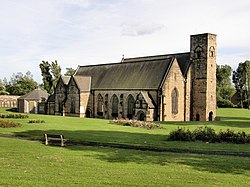
Monkwearmouth is an area of Sunderland, Tyne and Wear in England. Monkwearmouth is located at the north side of the mouth of the River Wear. It was one of the three original settlements on the banks of the River Wear along with Bishopwearmouth and Sunderland. It includes the area around St. Peter's Church, founded in 674 as part of Monkwearmouth-Jarrow Abbey, and was once the main centre of Wearside shipbuilding and coalmining in the town. It is now host to a campus of the University of Sunderland and the National Glass Centre. It is served by the three Church of England churches of the Parish of Monkwearmouth. The first nineteenth-century Catholic church built in Monkwearmouth was St Benet's Church which remains active today. Monkwearmouth is across the river from the Port of Sunderland at Sunderland Docks. The locals of the area were called "Barbary Coasters". The borough stretches from Wearmouth Bridge to the harbour mouth on the north side of the river and is one of the oldest parts of Sunderland. The former railway station, closed in 1968 by the Beeching Axe, is now the Monkwearmouth Station Museum and features a restored booking office dating from the Edwardian period. Since 2002, Monkwearmouth has once again been served by rail transport, this time via St Peter's Tyne and Wear Metro station a few hundred metres south of the old station. Wearmouth Colliery, a coal mine, was closed in December 1993 after it had been in operation for over 100 years. The site is now the home of the Stadium of Light, which opened in July 1997 and is the home of the football club Sunderland A.F.C., who had previously played at Roker Park. Monkwearmouth was part of the Sunderland North parliamentary constituency for elections to the House of Commons of the United Kingdom. Monkwearmouth is now part of Sunderland Central. In 1891 the civil parish had a population of 9116. On 25 March 1897 the parish was abolished and merged with Sunderland. In 1974 it became part of the metropolitan district of Sunderland.

Lieux à Proximité Voir Menu
Location Image
365 m

Stadium of Light

Le Stadium of Light est le stade de football du Sunderland AFC. Ce stade de 48 353 places est inauguré en 1997, par le prince Andrew, duc d'York, à l'occasion d'une rencontre entre le Sunderland AFC et l'Ajax Amsterdam.
Location Image
512 m

Pont de Wearmouth

Le pont de Wearmouth (en anglais : Wearmouth Bridge) est un pont en arc traversant la rivière Wear à Sunderland. C'est le dernier pont sur le fleuve avant son embouchure avec la mer du Nord. Le pont ferroviaire de Monkwearmouth (en) se situe en amont.
Location Image
514 m

Abbaye de Wearmouth-Jarrow

L’abbaye de Wearmouth-Jarrow, ou de Monkwearmouth-Jarrow, est une abbaye bénédictine, composée de deux monastères jumeaux, fondés en Northumbrie par Benoît Biscop, l’un en 674, l’autre en 682. Bien que ces monastères soient distants d'une dizaine de kilomètres, leur histoire est si étroitement liée qu’on associe le plus souvent leurs noms. Tous deux sont des monastères d’hommes : il ne s’agit donc pas d’un monastère double. Bède le Vénérable (figure illustre de Jarrow) en parle comme de « monastères jumeaux pour hommes ».
Location Image
536 m

Cité de Sunderland

La Cité de Sunderland (en anglais : City of Sunderland) est un district du Tyne and Wear, en Angleterre. Elle a le statut de district métropolitain et de cité (city). Elle porte le nom de sa principale ville, Sunderland, et couvre un territoire comprenant les villes de Hetton-le-Hole, Houghton-le-Spring, Washington, ainsi que des villages suburbains. Le district a été créé en 1974 sous le nom de District métropolitain de Sunderland (Metropolitan Borough of Sunderland) par le Local Government Act 1972. Il est issu de la fusion de quatre anciens districts du comté de Durham. Il a reçu le statut de cité en 1992, à l'occasion du 40e anniversaire de l'accession au trône de la reine Élisabeth II. Au recensement de 2001, la cité de Sunderland comptait 280 807 habitants, dont une majorité réside à Sunderland.
Location Image
559 m

Newcastle Road

Newcastle Road était un stade de football situé à Sunderland, en Angleterre. C'est le terrain du Sunderland AFC entre 1886 et 1898.