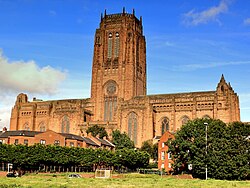
Liverpool Cathedral is a Church of England cathedral in the city of Liverpool, England. It is the seat of the bishop of Liverpool and is the mother church of the diocese of Liverpool. The church may be formally referred to as the Cathedral Church of Christ in Liverpool. It is the largest cathedral and religious building in Britain, and the eighth largest church in the world. The cathedral is based on a design by Giles Gilbert Scott and was constructed between 1904 and 1978. It is the longest cathedral in the world; the total external length of the building, including the Lady Chapel (dedicated to the Blessed Virgin), is 621 feet (189 m), its internal length is 480 feet (150 m). In terms of overall volume, Liverpool Cathedral ranks as the fifth-largest cathedral in the world and contests with the incomplete Cathedral of St. John the Divine in New York City for the title of largest Anglican church building. With a height of 331 feet (101 m) it is also one of the world's tallest non-spired church buildings and the fourth-tallest structure in the city of Liverpool. The cathedral is recorded in the National Heritage List for England as a designated Grade I listed building. The Anglican cathedral is one of two cathedrals in the city. The Roman Catholic Metropolitan Cathedral of Christ the King is situated approximately 0.5 miles (0.8 km) to the north. The cathedrals are linked by Hope Street, which takes its name from William Hope, a local merchant whose house stood on the site now occupied by the Philharmonic Hall, and was named long before either cathedral was built.

Lieux à Proximité Voir Menu
Location Image
0 m

Cathédrale de Liverpool

La cathédrale de Liverpool, en anglais « Cathedral Church of Christ in Liverpool », est la cathédrale anglicane de la ville de Liverpool, en Angleterre. Elle est le siège de l'évêque du diocèse de Liverpool. Construite principalement au XXe siècle, c'est la cinquième plus grande église du monde, et la plus grande église anglicane.
Location Image
0 m

Diocèse de Liverpool

Le diocèse de Liverpool est un diocèse anglican de la Province d'York qui s'étend sur le Merseyside au nord de la Mersey ainsi que sur le West Lancashire. Son siège est la cathédrale de Liverpool. Il est créé en 1880 à partir du diocèse de Chester. Le diocèse se divise en deux archidiaconés, à Liverpool même et à Warrington.
Location Image
459 m

Église Saint-Nicolas de Liverpool

L'église Saint-Nicolas (anglais : Church of St Nicholas) est un édifice religieux orthodoxe grec situé à Toxteth, à Liverpool, à la jonction de la rue Berkley et Princes Road. Construite dans le style architectural néo-byzantin, elle a été achevée en 1870. Les architectes étaient W. & J. Hay et l'église a été construite par Henry Sumners. Il s'agit d'une version agrandie de l'église Saint-Théodore de Constantinople (maintenant convertie en mosquée Vefa Kilise). C'est un monument classé de Grade II.
Location Image
597 m

Princes Road Synagogue

Princes Road Synagogue est une synagogue située à Toxteth, à Liverpool. Elle a été fondée à la fin des années 1860, conçue par William James Audsley et George Ashdown Audsley et consacrée le 2 septembre 1874. Elle est largement considérée comme le plus bel exemple du style néo-mauresque de l'architecture des synagogues en Grande-Bretagne . Des synagogues imitant sa conception se trouvent jusqu'à Sydney.
Location Image
668 m

Everyman Theatre

L’Everyman Theatre est un théâtre de Liverpool, en Angleterre, établi en 1964. Il est célèbre pour les drames locaux et contemporains qui y sont donnés. Il a été fondé en 1964, dans le Hope Hall (autrefois une chapelle, puis un cinéma), dans un quartier de Liverpool connu pour son environnement bohème et son côté politique, et s'est rapidement forgé une réputation pour ses œuvres révolutionnaires. L'Everyman a été entièrement reconstruit entre 2011 et 2014.