
Location Image

Porch House, Northallerton

Porch House is a historic building in Northallerton, a town in North Yorkshire, in England. The building was constructed in 1584 for Richard Metcalfe, with an open hall. A wing was added to the rear right in the mid 17th century, then in 1684 a large two-storey porch was added, giving the house its name. In the late 17th century, a floor was inserted in the hall, then in 1781 the building was extensively altered, the work including the addition of a range to the left, and the replacement of the thatched roofs with pantiles. In 1844, the building was further altered, and the porch was demolished and replaced with a single-storey structure. Perhaps at this time, the house was divided into three properties. Railings were installed in front of the house, to protect it during the town's cattle market. Local tradition claims that Charles I of England stayed in the house in 1640 and then was imprisoned there in 1647 before being handed over to Oliver Cromwell. A local legend claims that a secret tunnel connects the house with All Saints' Church, Northallerton, but no tunnel has been discovered. The Metcalfe family later became the Marwood family, and owned the house until 1988. It was marketed for sale in 2009, for £500,000. It has since operated as a guest house. It has been grade II listed since 1969. The house has a timber framed core, it is enclosed in brick, and has a pantile roof. It has two storeys, a range of four bays, and a projecting cross-wing on the left with a hipped roof. In the centre of the main range is a single-storey sandstone porch containing a doorway with an ogee-shaped lintel, and a coped gable with a finial. The windows are a mix of horizontally-sliding sashes and casements. The cross-wing contains a two-storey canted bay window and a doorway to the right. In front of the house are wrought iron railings on a low wall.

Lieux à Proximité Voir Menu
Location Image
667 m

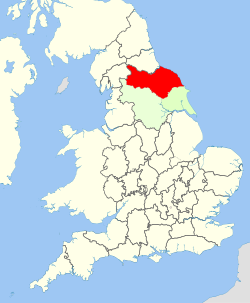
North Riding of Yorkshire

Le North Riding of Yorkshire est l'une des trois subdivisions historiques du comté de Yorkshire, en Angleterre. Il constitue également un comté administratif de 1889 à 1974.
Location Image
671 m

Northallerton

Northallerton est une ville marchande et une paroisse civile du Yorkshire du Nord, en Angleterre. Elle se trouve dans la vallée de Mowbray et à l'extrémité nord du val d'York. Sa population s'élève à 15 741 personnes selon le recensement de 2001. C'était la capitale du North Riding of Yorkshire, et depuis 1974 elle est devenue celle du Yorkshire du Nord. La région est peuplée depuis l'époque romaine, mais la ville n'a pris de l'importance qu'à partir du XIe siècle quand Guillaume II d'Angleterre donne les terres à l'évêque de Durham. Sous l'autorité de l'évêque Northallerton devient un centre religieux majeur. Elle est également située au en plein cœur du conflit entre les royaumes d'Angleterre et d'Écosse, notamment au moment de la bataille de l'Étendard, vers 1138, durant laquelle 12 000 hommes trouvent la mort Plus récemment le commerce et le transport ont pris une nouvelle importance dans la ville. Sa situation sur la route principale entre l'Écosse et Londres en fait une halte importante pour les bus qui parcourent ce trajet. Elle est la ville de naissance du footballeur Michael dawson ( 1983-)
Location Image
1.0 km

Hambleton (district)

Hambleton est un ancien district non métropolitain du Yorkshire du Nord, en Angleterre, dont le siège était Northallerton. il a existé de 1974 à 2023.
Location Image
1.6 km

Romanby

Romanby est un village et une paroisse civile du Yorkshire du Nord, en Angleterre.
Location Image
2.4 km

Brompton (Yorkshire du Nord)

Brompton est un village, une paroisse civile et un quartier électoral du Yorkshire du Nord, en Angleterre, à environ 2,6 km au nord de la ville de Northallerton. Pratiquement une banlieue de la ville voisine, le village est près du site d'une bataille entre les armées anglaises et écossaises : la bataille de l'Étendard. Des tissages s'y installent à partir du XVIIIe siècle. Avec 2 055 habitants, ce village s'est considérablement développé depuis les années 1800.