The City Hotel (1794–1849) stood at 123 Broadway, occupying the whole block bounded by Cedar, Temple, and Thames Streets, in today's Financial District of Manhattan, New York City. It was the first functioning hotel in the United States. Until the early 1840s it was the city's principal site for prestigious social functions and concerts. Designed by John McComb Jr., it offered not only luxurious accommodations, but also such amenities as shops, a barroom, and a coffeehouse, as well as public dining and dancing. Its five stories and 137 rooms replaced the former home of Stephen Delancey, built around 1700, which had become an inn. An 1825 guide-book, first published in 1817, calls it "an immense building, 5 stories in height, [which] contains 78 rooms of various dimensions, fitted up and furnished in a tasteful, elegant and convenient manner … the proprietor of this Hotel makes it his constant study to provide the best of every thing to his visitors." An 1828 expanded edition states:

City Hotel, [operated] by Chester Jennings, is the chief place of resort, and … the loftiest edifice of that kind in the city, containing more than one hundred large and small parlours and lodging-rooms, besides the City Assembly Room, chiefly used for Concerts and Balls. The rooms appropriated for private families, parlours, and dining rooms are superbly fitted up, and constantly occupied by respectable strangers. Extensive additions have recently been made to this establishment. The principal Book stores and Libraries are in the vicinity. Prices, over two days, $1.50 per day, $10 per week, $416 per year—Board only, $5.50 per week, dinner only, $3.50 per week. Upon its closing on April 30, 1849, the New York Herald wrote: "In times gone by, it was the first hotel of the country, and the great men of the country always patronized it … ". It was once owned by Ezra Weeks. In 1828 John Jacob Astor bought it. He gave it to a granddaughter, Sara Langdon, who married Francis Robert Boreen in 1834, as a dowry. In 1849–50 she replaced it with a block of stores called the Boreel Building, and in 1878–79 replaced that with an office building, also called the Boreel Building.

1. See also

List of former hotels in Manhattan

1. References


1. External links

Media related to City Hotel (Manhattan) at Wikimedia Commons

40°42′32.5″N 74°0′40.2″W

Lieux à Proximité Voir Menu
Location Image
18 m

Académie des sciences de New York

L'Académie des sciences de New York (en anglais New York Academy of Sciences) est une société savante ouverte potentiellement à tout universitaire et regroupant vingt mille scientifiques de toutes disciplines provenant de cent-vingt pays. Son but est de faire avancer les connaissances scientifiques, technologiques et médicales et de stimuler de nouvelles façons d'envisager d'appliquer les découvertes scientifiques dans les sociétés humaines, à travers la planète. Depuis 1949, elle a pour siège son propre immeuble situé au 2 East 63rd Street, New York — un immeuble néo-Renaissance construit en 1919.
Location Image
42 m

Parc Zuccotti

Le parc Zuccotti (Zuccotti Park), anciennement connu sous le nom de Liberty Plaza Park, est un parc public et une place situés dans le quartier de Lower Manhattan, dans le sud de l'arrondissement de Manhattan à New York, aux États-Unis. Propriété de Brookfield Office Properties (en), le parc est nommé en l'honneur de John E. Zuccotti (en) après sa rénovation de 2006. Le parc est situé entre les rues Broadway, Trinity Place, Liberty Street (Manhattan) et Cedar Street.
Location Image
42 m

Occupy Wall Street

Occupy Wall Street (OWS) ou Occupy New York (en français : « Occupons Wall Street/New York ») est un mouvement de manifestation de contestation pacifique dénonçant les abus du capitalisme financier. Le mouvement débute le 17 septembre 2011 alors qu'environ 1 000 personnes manifestent dans les environs de Wall Street, le quartier de la bourse à New York. Une partie des manifestants érigent des installations de fortune dans le parc Zuccotti, « occupant » l'endroit dans une sorte de sit-in. Au cours des semaines suivantes, plusieurs centaines de manifestants vivent et dorment dans le parc. Très actif sur les réseaux sociaux, le mouvement s'inspire du printemps arabe, en particulier des révolutions tunisienne et égyptienne, ainsi que du mouvement des Indignés en Espagne. À partir du 9 octobre, le mouvement s'étend à l'ensemble des États-Unis et des manifestations similaires se tiennent dans 70 grandes métropoles avec la participation de 600 communautés. Le 15 octobre, date choisie pour être la première journée mondiale de protestation pour de vraies démocraties, le mouvement Occupy s'étend dans environ 1 500 villes de 82 pays. À la mi-novembre, dans la nuit du 14 au 15, les manifestants sont expulsés du parc par la police de New York, qui y interdit le campement. Malgré la fin de l'occupation, le mouvement poursuit des moyens de pression, notamment par des actions éclair et ciblées[source insuffisante].
Location Image
55 m

Trinity Building

Le Trinity Building est un gratte-ciel de New York construit en 1905. Il s'élève à une centaine de mètres sur 22 étages.
Location Image
79 m

One Liberty Plaza

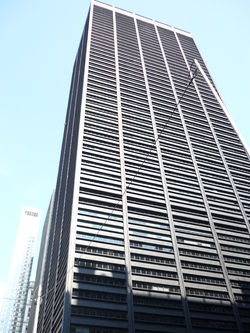
Le One Liberty Plaza, initialement U.S. Steel Building, est un gratte-ciel situé dans l'arrondissement de Manhattan, à New York. Il compte cinquante-quatre étages et mesure 226 mètres. Construit dans le quartier du World Trade Center, le One Liberty Plaza a été gravement endommagé durant les attentats du 11 septembre 2001 au point que l'on a craint une chute de l'édifice. Le gratte-ciel possède une station de métro dans ses sous-sols et a un temps abrité les quartiers généraux de la société boursière du NASDAQ.