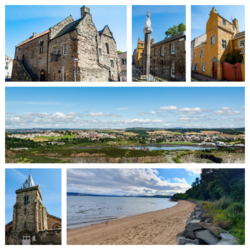
Location Image

Battle of Inverkeithing

The Battle of Inverkeithing was fought on 20 July 1651 between an English army under John Lambert and a Scottish army led by James Holborne as part of an English invasion of Scotland. The battle was fought near the isthmus of the Ferry Peninsula, to the south of Inverkeithing, after which it is named. An English Parliamentary regime had tried, convicted, and executed Charles I, who was king of both Scotland and England in a personal union, in January 1649. The Scots recognised his son, also named Charles, as king of Britain and set about recruiting an army. An English army, under Oliver Cromwell, invaded Scotland in July 1650. The Scottish army, commanded by David Leslie, refused battle until 3 September when it was heavily defeated at the Battle of Dunbar. The English occupied Edinburgh and the Scots withdrew to the choke point of Stirling. For nearly a year all attempts to storm or bypass Stirling, or to draw the Scots out into another battle, failed. On 17 July 1651 1,600 English soldiers crossed the Firth of Forth at its narrowest point in specially constructed flat-bottomed boats and landed at North Queensferry on the Ferry Peninsula. The Scots sent forces to pen the English in and the English reinforced their landing. On 20 July the Scots moved against the English and in a short engagement were routed. Lambert seized the deep-water port of Burntisland and Cromwell shipped over most of the English army. He then marched on and captured Perth, the temporary seat of the Scottish government. Charles and Leslie took the Scottish army south and invaded England. Cromwell pursued them, leaving 6,000 men to mop up the remaining resistance in Scotland. Charles and the Scots were decisively defeated on 3 September at the Battle of Worcester. On the same day the last major Scottish town holding out, Dundee, surrendered.

Lieux à Proximité Voir Menu
Location Image
1.9 km

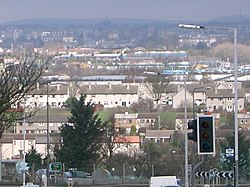
Rosyth

Rosyth (se prononce « Ross-sythe » ; Ros Fhìobh en gaélique (gd), mais on rencontre aussi parfois Ros Saidhe ou Ros Saoithe) est une ville située sur l'estuaire de la rivière Forth, le Firth of Forth, sur la côte est de l'Écosse. Au sud, à environ 1,6 kilomètre, se situe Dunfermline, et Fife, à environ 19 kilomètres au nord-ouest d'Édimbourg, et Lothian au sud.
Location Image
2.6 km

Bataille d'Inverkeithing

La bataille d'Inverkeithing se déroule le 20 juillet 1651, à Inverkeithing en Écosse. Elle est l'une des dernières batailles de la guerre anglo-écossaise de 1650-1652. Les troupes parlementaires de la New Model Army commandées par John Lambert remportent la victoire sur l'armée royaliste, prédominément écossaise, de Charles II d'Angleterre, menée par David Leslie (en).
Location Image
2.6 km

Inverkeithing

Inverkeithing est une ville qui se trouve dans la banlieue d'Edimbourg et un ancien burgh royal du comté de Fife en Écosse. Selon le recensement de 2006, la population de la ville est de 5 265 habitants. Son port a reçu le statut de burgh du roi David Ier d'Écosse (1124- 1153) au XIIe siècle. La ville se situe à environ 9 kilomètres de l'aéroport d'Édimbourg et à 6 km de Dunfermline, le chef-lieu du comté. La ville jouxte Rosyth et Dagelty Bay.
Location Image
2.7 km

HMS Scotia (établissement terrestre)

Le HMS Scotia est un établissement terrestre de la Royal Naval Reserve à Rosyth, en Écosse. Il est une des plus récentes unités du RNR qui habite un hébergement spacieux et moderne avec d'excellentes installations, dont le siège est dans l'enceinte du MoD Caledonia (en), au nord du chantier naval de Rosyth et dispose d'excellentes liaisons de communication par rail et par air.
Location Image
3.0 km

Dunfermline

Dunfermline (en gaélique écossais : Dùn Phàrlain ; en scots : Dunfaurlin ou Auld Grey Toun) est une ville (et ancien burgh royal) écossaise située dans le Council area et région de lieutenance du Fife. De 1975 à 1996, elle était la capitale administrative du district de Dunfermline, au sein de la région du Fife. La ville est depuis longtemps un centre industriel qui doit sa prospérité aux mines de charbon et au tissage du lin. Aujourd'hui, ce sont les industries modernes qui ont pris la relève. Dunfermline a connu une grande expansion démographique avec la création de nouveaux quartiers de logements pour des populations travaillent à Édimbourg, lui donnant une nouvelle image stéréotypée de ville-dortoir. David Ier fonda vers 1070 à Dunfermline une abbaye de bénédictins. Cette ville fut jadis la résidence et le lieu de sépulture des rois d'Écosse. Elle fut dévastée par un grand incendie en 1604, puis par la peste en 1615 et en 1651. Dunfermline est la ville natale de Charles Ier d'Angleterre qui est né au palais de Dunfermline, d'Andrew Carnegie, du multi-instrumentiste Ian Anderson (Jethro Tull), du groupe de punk rock The Skids et du groupe de hard rock Nazareth.