

 English
 Français

Sheffield
Sheffield is a city in South Yorkshire, England, situated 29 miles (47 km) south of Leeds and 32 miles (51 km) east of Manchester. The city is the administrative centre of the City of Sheffield. It is historically part of the West Riding of Yorkshire. It is the largest settlement in South Yorkshire, and the third largest in Northern England. The city is in the eastern foothills of the Pennines and the valleys of the River Don with its four tributaries: the Loxley, the Porter Brook, the Rivelin and the Sheaf. Sixty-one per cent of Sheffield's entire area is green space and a third of the city lies within the Peak District national park and it is the fifth-largest city in England. There are more than 250 parks, woodlands and gardens in the city, which is estimated to contain around 4.5 million trees. Sheffield played a crucial role in the Industrial Revolution, developing many significant technologies. In the 19th century, the city saw a huge expansion of its traditional cutlery trade, when processes for high-quality stainless steel and crucible steel were invented. This fuelled an almost tenfold increase in the population. Sheffield received its municipal charter in 1843, becoming the City of Sheffield in 1893. International competition in iron and steel caused a decline in these industries in the 1970s and 1980s, coinciding with the collapse of coal mining in the area. The Yorkshire ridings became counties in their own right in 1889; the West Riding of Yorkshire county was disbanded in 1974. The city then became part of the county of South Yorkshire; this has been made up of separately governed unitary authorities since 1986. The 21st century has seen extensive redevelopment in Sheffield, consistent with other British cities. Sheffield's gross value added (GVA) has increased by 60% since 1997, standing at £11.3 billion in 2015. The economy has experienced steady growth, averaging around 5% annually, which is greater than that of the broader region of Yorkshire and the Humber. Sheffield had a population of 556,500 at the 2021 census, making it the second-largest city in the Yorkshire and the Humber region. The Sheffield Built-up Area, of which the Sheffield sub-division is the largest part, had a population of 685,369 also including the town of Rotherham. The district borough, governed from the city, had a population of 582,493 at the mid-2019 estimate, making it the 7th-most-populous district in England. It is one of eleven British cities that make up the Core Cities Group. In 2011, the unparished area had a population of 490,070. The city has a long sporting heritage and is home both to the world's oldest football club, Sheffield F.C., and the world's oldest football ground, Sandygate. Matches between the two professional clubs, Sheffield United and Sheffield Wednesday, are known as the Steel City derby. The city is also home to the World Snooker Championship and the Sheffield Steelers, the UK's first professional ice hockey team.
Lieux à Proximité Voir Menu

Diocèse de Sheffield

Cathédrale Sainte-Marie de Sheffield

Women of Steel
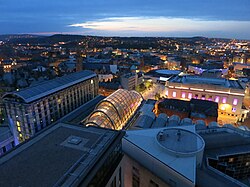
Sheffield Winter Gardens
