Location Image

Langdale axe industry

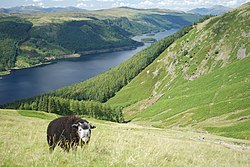
The Langdale axe industry (or factory) is the name given by archaeologists to a Neolithic centre of specialised stone tool production in the Great Langdale area of the English Lake District. The existence of the site, which dates from around 4,000–3,500 BC, was suggested by chance discoveries in the 1930s. More systematic investigations were undertaken by Clare Fell and others in the 1940s and 1950s, since when several field surveys of varying scope have been carried out. Typical finds include reject axes, rough-outs and blades created by knapping large lumps of the rock found in the scree or perhaps by simple quarrying or opencast mining. Hammerstones have also been found in the scree and other lithic debitage from the industry such as blades and flakes. The area has outcrops of fine-grained greenstone or hornstone suitable for making polished stone axes. Such axes have been found distributed across Great Britain. The rock is an epidotised greenstone quarried or perhaps just collected from the scree slopes in the Langdale Valley on Harrison Stickle and Pike of Stickle. The nature and extent of the axe-flaking sites making up the Langdale Axe Factory complex are still under investigation. Geological mapping has established that the volcanic tuff used for the axes outcrops along a narrow range of the highest peaks in the locality. Other outcrops in the area are known to have been worked, especially on Harrison Stickle, and Scafell Pike where rough-outs and flakes have been found on platforms below the peaks at and above the 2000- or 3000-foot level. Recent research has shown that Langdale tuff was used for tools before the Neolithic 'axe factories' were established. In Maryport (Cumbria) it was selected for tool manufacture in the Final Palaeolithic and Mesolithic

Lieux à Proximité Voir Menu
Location Image
0 m

Industrie des haches de Langdale

L'industrie des haches de Langdale est une industrie lithique spécialisée, datant du Néolithique et découverte à Great Langdale (en), en Angleterre, dans le Lake District.
Location Image
2.4 km

Parc national du Lake District

Le Lake District est un parc national anglais qui fait partie du Cumbria. Avec ses 2 280 km2 de lacs et de montagnes, c'est le plus grand parc national d'Angleterre. On y trouve les montagnes les plus hautes d'Angleterre, dont Scafell Pike (978 m), son point culminant. La région, royaume du randonneur, est connue pour être l'inspiration des Lakistes, notamment William Wordsworth.
Location Image
2.7 km

Allan Bank

Allan Bank est une villa de deux étages classée grade II, située sur un terrain élevé légèrement à l'ouest du village de Grasmere, au cœur du Lake District. Elle est surtout connue pour avoir été de 1808 à 1811 la demeure de William Wordsworth, mais elle est également occupée à diverses époques par Dorothy Wordsworth, Dora Wordsworth, Thomas de Quincey, Samuel Taylor Coleridge, Thomas Arnold, Matthew Arnold et le chanoine Hardwicke Rawnsley. Elle appartient maintenant au National Trust et est ouverte au public.
Location Image
2.8 km

Grasmere

Grasmere est un village d'Angleterre. C'est une destination touristique champêtre. Le poète William Wordsworth, qui y vécut pendant 14 ans, déclara que c'est le meilleur endroit que l'Homme ait jamais trouvé. Il est situé dans le district de South Lakeland dans le comté de Cumbria.
Location Image
2.9 km

Église Saint-Oswald de Grasmere

L'église Saint-Oswald (anglais : St Oswald's Church) se trouve dans le village de Grasmere, dans le Lake District, Cumbria, Angleterre. C'est une église paroissiale anglicane dans le doyenné de Windermere, l'archidiaconé de Westmorland et Furness et le diocèse de Carlisle. L'église est inscrite dans la liste du patrimoine national pour l'Angleterre comme bâtiment de grade I. En plus de son intérêt architectural, l'église est remarquable pour ses associations avec le poète, William Wordsworth et sa famille, et pour sa cérémonie annuelle de rushbearing.