Location Image

Barrow-in-Furness Main Public Library

Barrow-in-Furness Main Public Library (more usually known as Barrow Central Library or Barrow Library) is a Grade II listed Beaux-Arts style building located at Ramsden Square, Barrow-in-Furness, England. Operated since 2023 by Westmorland and Furness Council, it is the largest library in the town and the present structure, designed by J A Charles was originally built as a Carnegie library with support from the Carnegie Foundation. The first library in Barrow was opened on 18 September 1882 in temporary iron buildings in Schneider Square; in 1887 this was transferred to a room within Barrow Town Hall. The growing population meant that a larger building was needed and this was eventually met by the construction of the present accommodation at the junction of Abbey Road with Ramsden Square. The building itself bears a date of 1915 (denoted by an engraving by the main entrance which reads 'ANNO DNI MCMXV'), although delays brought about by World War I meant that it wasn't actually completed and opened until 1922. The library formerly housed the Furness Museum which held artefacts both from across the world and also from the local area. The museum (always operated by Barrow Borough Council) was opened in 1930 in an upstairs lecture room. It closed in 1991 and most of the exhibits were eventually moved to larger purpose-built premises next to Walney Channel - the Dock Museum. After building modifications in 1998, the library has also worked with the Cumbria Archive Service in the joint operation of a local archives or county record office branch. This now shares a public searchroom together with the local studies library. Besides the Central Library there are currently five other libraries in the present borough: Askam, Barrow Island, Dalton, Roose and Walney. A sixth branch at Ormsgill has now been replaced by a library link facility in Ormsgill Children's Centre

Lieux à Proximité Voir Menu
Location Image
537 m

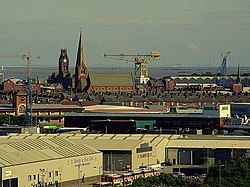
Barrow-in-Furness

Barrow-in-Furness est une ville portuaire et industrielle de Cumbria, située dans le nord-ouest de l'Angleterre au Royaume-Uni. En 2011, Barrow-in-Furness avait une population de 55 489 habitants.
Location Image
599 m

Barrow-in-Furness (district)

Barrow-in-Furness était un district non métropolitain de Cumbria, en Angleterre. Il avait le statut de borough. Barrow-in-Furness a été intégrée dans une nouvelle entité administrative. Aujourd'hui, maintenat cette zone fait partie du district unitaire de Westmorland and Furness, résultant d'une réorganisation territoriale visant à améliorer la gestion locale. Il portait le nom de sa principale ville, Barrow-in-Furness. Les autres principales villes du district sont Dalton-in-Furness, Roose et Askam-in-Furness. C'est le plus petit district du comté, et le plus densément peuplé. Le district etait créé le 1er avril 1974. Il etait issu de la fusion de l'ancien borough de Barrow-in-Furness et du district urbain de Dalton-in-Furness.
Location Image
1.1 km

Pont de Walney

Le pont de Walney (en anglais : Walney Bridge), officiellement nommé Jubilee Bridge, est un pont basculant situé à Barrow-in-Furness, Cumbria, en Angleterre. Achevé en 1908, il enjambe le chenal Walney, et relie l’île Barrow à l’île Walney. La route nationale A590, qui a son terminus ouest sur Walney, passe sur le pont.
Location Image
1.3 km

Barrow (île)

L'île Barrow est une ancienne île de la ville de Barrow-in-Furness, dans le comté de Cumbria en Angleterre. Originellement séparée de la Grande-Bretagne, elle a été reliée au continent en 1860. Elle est séparée de l'île de Walney par le détroit de Walney.
Location Image
1.5 km

Chenal Walney

Le chenal Walney (en anglais : Walney Channel) sépare l’île Walney du continent britannique. La partie nord du chenal s’ouvre sur l’estuaire du Duddon. Elle est à la fois la plus étroite et la moins profonde. La moitié sud du chenal est plus large, et elle est régulièrement draguée pour permettre aux navires d’accéder au port de Barrow-in-Furness. Cette moitié s’ouvre sur la baie de Morecambe. Le chenal est enjambé par le pont de Walney (officiellement Jubilee Bridge) achevé en 1908. En raison des besoins de la navigation, en particulier des activités du chantier naval Vickers, il a été construit comme un pont basculant.