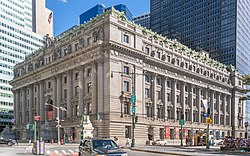
Bowling Green is a small historic public park in the Financial District of Lower Manhattan in New York City, at the southern end of Broadway. Built in the 18th century next to the site of the original Dutch fort of New Amsterdam, it served as a public gathering place and under the British was designated as a park in 1733. It is the oldest public park in New York City and is surrounded by its original 18th-century cast iron fence. The park included an actual bowling green and a monumental equestrian statue of King George III prior to the American Revolutionary War. Pulled down in 1776, the 4000-pound statue is said to have been melted for ammunition to fight the British. Bowling Green is adjacent to another historic park, the Battery, located to the southwest. It is surrounded by several buildings, including the Alexander Hamilton U.S. Custom House (with the NYC office of the National Archives), the International Mercantile Marine Company Building, Bowling Green Offices Building, Cunard Building, 26 Broadway, and 2 Broadway. The Charging Bull sculpture is located on the northern end of the park. The park is listed on the U.S. National Register of Historic Places under the name Bowling Green Fence and Park. It is also a contributing property to the Wall Street Historic District, an NRHP district created in 2007.

Lieux à Proximité Voir Menu
Location Image
0 m

Bowling Green (New York)

Le Bowling Green est un petit jardin public du quartier de Lower Manhattan à New York, situé au pied de Broadway, près du site du quartier hollandais de La Nouvelle-Amsterdam. Construit en 1733, son nom vient du fait qu'il comportait à l'origine un boulingrin (bowling green). En forme de goutte d'eau, il est le parc public le plus ancien de New York, et il est encore à ce jour entouré par une barrière datant du XVIIIe siècle. Au nord du jardin se trouve la sculpture du taureau de Wall Street (Charging Bull). Le Bowling Green Fence and Park fait partie du Registre national des lieux historiques.
Location Image
47 m

Taureau de Wall Street

Le Taureau de Wall Street (en anglais Charging Bull, Wall Street Bull ou Bowling Green Bull) est une sculpture en bronze de l'artiste italien Arturo Di Modica située au Bowling Green Park, près de la bourse de New York (Wall Street) aux États-Unis.
Location Image
56 m

New York Produce Exchange

Le New York Produce Exchange était un marché à terme agricole de New York. Fondé en 1861, il avait dans les années 1880 plus de membres qu'aucune autre une bourse à terme des États-Unis. Son siège, le Bowling Green a été le premier bâtiment au monde à combiner le fer forgé et la maçonnerie dans sa structure de construction. Il a été démoli en 1957.
Location Image
76 m

26 Broadway

Le 26 Broadway est un gratte-ciel de style néoclassique de bureaux de 159 mètres de hauteur construit à New York en 1924. À l'origine l'immeuble abritait des locaux d'une des branches de la Standard Oil. L'immeuble a été conçu par les agences Shreve, Lamb & Blake, Kimball & Thompson, Carrère & Hastings (en). La surface de plancher de l'immeuble est de 60 376 m2.
Location Image
80 m

Alexander Hamilton U.S. Custom House

La Alexander Hamilton U.S. Custom House est une maison de douane (Custom House) érigée en 1902–1907 par le gouvernement fédéral pour abriter les opérations de perception des droits pour le port de New York. Conçu par Cass Gilbert dans le style Beaux-Arts, il se trouve au 1 Bowling Green dans le Financial District près de la pointe sud de Manhattan à New York, à peu près au même endroit que Fort Amsterdam et Government House.