
Location Image

Scarborough Town Wall

The Scarborough Town Wall was a fortification surrounding Scarborough, North Yorkshire, a town in England. The borough of Scarborough was founded in the 12th century. A wall was built on the landward side of the town, from the a ditch at junction of Auborough and Cross Street, to the sea. It was then continued along what is now Eastborough, either as a wall or a wooden palisade. This ran partly along the line of the cliff and terminated at the castle. A ditch was dug outside the wall. The defences were first recorded in 1225, when the town was granted forty oak trees and three years of tolls on shipping to maintain them. In 1283/4, the monks of Blackfriars applied to demolish the wall, but this was opposed by the town burgesses, and the wall was instead maintain into the 14th century. Houses were then built up against the wall, and it was gradually removed to provide stone for new construction elsewhere. Perhaps in the late 15th century, a wall was constructed further west, and this was maintained into the 16th century, with substantial foundations still visible at the end of the 18th century. The gate on Auborough, which John Leland described as "very base", was demolished at an early date, but the gate on Newborough which Leland called "meatley good", survived until 1843. That year, it was demolished and replaced by a new gate in a neo-Gothic style, but this was demolished in 1890. Two small, curved, sections of wall survive off St Thomas Street. They date from the 15th century, were added to in the 17th century, and repaired in the 19th century. They are built of stone surmounted by brick, and are rendered. Both sections have buttresses and they are jointly grade II listed. The ditch is not visible, but excavations near St Mary's Parish House showed it to be 9 metres wide and up to 4.4 metres deep.

Lieux à Proximité Voir Menu
Location Image
526 m

Scarborough (Yorkshire du Nord)

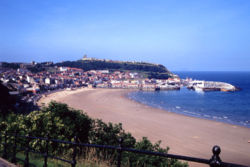
Scarborough est une ville sur la mer du Nord dans le comté du Yorkshire du Nord en Angleterre, Royaume-Uni. La ville moderne se situe entre 30 et 70 m au-dessus du niveau de la mer sur des falaises calcaires. La vieille ville entoure le port qui est protégé par une pointe de rocher. Les villes situées à proximité comprennent Kingston-upon-Hull, York et Leeds.
Location Image
548 m

Grand Hotel (Scarborough)

Le Grand Hotel est un hôtel de Scarborough dans le Yorkshire du Nord en Angleterre.
Location Image
593 m

Scarborough (district)

Scarborough est un ancien district non métropolitain du Yorkshire du Nord, en Angleterre, au Royaume-Uni, dont le siège était Scarborough. Il a existé de 1974 à 2023.
Location Image
794 m

Phare de Scarborough

Le phare de Scarborough est un phare situé sur une jetée du vieux port de Scarborough, dans le comté du Yorkshire du Nord en Angleterre. Ce phare est géré par l'autorité portuaire de Scarborough. Il est maintenant protégé en tant que monument classé du Royaume-Uni de Grade II.
Location Image
839 m

Château de Scarborough

Le château de Scarborough est une ancienne forteresse royale du Moyen Âge, située sur un promontoire rocheux surplombant la mer du Nord, à Scarborough, Yorkshire du Nord, en Angleterre. Le site comprend un habitat de l'âge du fer, un poste de guet romain, un établissement anglo-scandinave comportant une chapelle, ainsi qu'une enceinte du XIIe et une batterie du XVIIIe siècle, l'ensemble formant un scheduled monument d'importance nationale. Les fortifications d'un château en bois ont été établies vers 1130, mais le présent château fort en pierre date des années 1150. Au fil des siècles, plusieurs autres structures ont été ajoutées, avec la volonté des différents monarques médiévaux de renforcer massivement cette importante forteresse qui gardait les côtes du Yorkshire et préservait le port de commerce de Scarborough d'éventuelles invasions écossaises ou continentales. Le château a été fortifié et défendu pendant les différentes guerres civiles, les sièges et les conflits qui opposaient les rois aux barons locaux, puis face à la rébellion et aux affrontements républicains, jusqu'à la conclusion de la paix avec l'Écosse et la fin des guerres civiles et continentales dans le courant du XVIIe siècle, qui ont conduit à son déclin. Le château de Scarborough est devenu un important site touristique à la fin du XIXe siècle.