Location Image

St Matthew's Church, Paisley

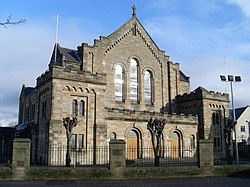
St Matthew's Church in Paisley is notable for its Art Nouveau architecture by WD McLennan, and stained glass window by Robert Anning Bell. The church was built between 1905 and 1907 (1907) and shares a small traffic island on Gordon Street with a (now disused) fire station. Originally called St George's East Free Church, it became a Church of Scotland with reunification in 1929, and was later renamed St Matthew's. Due to falling numbers, the church closed in 1988 and was taken over by the Church of the Nazarene, who had previously been meeting in a hall in nearby Orchard Street. Twenty-eight existing members St Matthews joined with the congregation from the Nazarene church. The architecture of St Matthew's is described by Historic Scotland as an "Art Nouveau interpretation of Perpendicular Gothic". It was designed by William Daniel McLennan, from Paisley, who was himself a member of the congregation. McLennan, a contemporary of Charles Rennie Mackintosh, was notable for his Art Nouveau architecture, which is found in a number of houses in Paisley as well as the Bull Inn and another church in the Ralston area of the town. The original plans included a massive spire but this idea was abandoned. McLennan also designed the interior furnishings, including the organ case, font and pulpit, and exterior features such as the railings and notice board. The church interior consists of a wide nave with galleries to the right side and the rear. The pulpit on the left-hand side features a wooden crown of thorns above. The right of the choir features a large organ, which is still in use. A number of small rooms are found around the church along with halls to the rear. A tulip motif appears throughout the building, featuring on woodwork, stone, stained glass, the pulpit's brass lectern, and even the light switches. The windows are mostly plain white with small coloured-glass features. The exception is the huge stained-glass window on the west side behind the choir, which is by Robert Anning Bell. This is not the original (which was similar in design to the others) but was replaced as a memorial to the Great War. St Matthew's bears comparison with Mackintosh's Queen's Cross Church in Glasgow (which is no longer used as a church). Some consider it to be the most significant Art Nouveau church in Scotland.

Lieux à Proximité Voir Menu
Location Image
304 m

Abbaye de Paisley

L’abbaye de Paisley est un ancien monastère clunisien, devenu église de paroisse de l’Église d’Écosse. Elle se situe sur la rive Est de la White Cart Water (de), au centre de la ville de Paisley, dans le Renfrewshire, en Écosse.
Location Image
432 m

Paisley (Écosse)

Paisley (gaélique écossais (gd) : Pàislig) est une ville (et ancien burgh) d'Écosse située dans les Lowlands d'Écosse. Elle est située de chaque côté de la rivière Cart, au nord de Gleniffer Braes, approximativement à 11,1 kilomètres à l'ouest-sud-ouest de Glasgow. C'est le centre administratif du council area, de la région de lieutenance et ancien comté de Renfrewshire. De 1975 à 1996, elle était la capitale administrative du district de Renfrew, au sein de la région du Strathclyde. L'abbaye de Paisley fut fondée durant le XIIe siècle. Une bourgade commença à se former autour de celle-ci. Elle reçut une charte royale de bourg en 1488. Elle devint connue aux XVIIe et XIXe siècles pour sa production textile, en particulier pour un motif qui porte son nom (voir Paisley (motif)). Paisley figure maintenant parmi les plus grandes municipalités d'Écosse par le nombre d'habitants, devant East Kilbride (pop. 73 796) mais derrière Glasgow, Édimbourg, Aberdeen et Dundee.
Location Image
617 m

Diocèse de Paisley

Le diocèse de Paisley (en latin : dioecesis Pasletana ; en anglais : diocese of Paisley) est une Église particulière de l'Église catholique au Royaume-Uni. Érigé en 1947, il couvre le Renfrewshire, un comté historique d'Écosse. Son siège est la cathédrale Saint-Mirin de Paisley. Il est un diocèse suffragant de l'archidiocèse de Glasgow. On comptait en 2004 près de 79 400 baptisés pour 342 000 habitants.
Location Image
687 m

Cathédrale Saint-Mirin de Paisley

La cathédrale Saint-Mirin est située sur Incle Street, à Paisley en Écosse. Elle porte le nom de saint Mirin. Elle a été achevée en 1931 à proximité du site de l'ancienne église du même nom qui date de 1808. Le bâtiment originel a été le premier édifice catholique construit après la Réforme écossaise. Le bâtiment actuel a été élevé au rang de cathédrale en 1948 après la création du diocèse l'année précédente.
Location Image
717 m

Observatoire Coats

L’Observatoire Coats (Coats Observatory) est l'un des quatre observatoires astronomiques publics du Royaume-Uni. Il est situé à Paisley, en Écosse, et a été conçu par l'architecte John Honeyman sur un financement local en provenance du propriétaire de filatures Thomas Coats. La conception a intégré de nombreuses caractéristiques de l'architecture victorienne. Le bâtiment fut ouvert le 1er octobre 1883. Le télescope utilisé date de 1889. En 1901, du matériel d'enregistrement sismique fut intégré dans un pavillon. Il fut démoli vers 1930 mais l'observatoire continue à fonctionner comme une station de surveillance sismique du British Geological Survey.