

 English
 Français
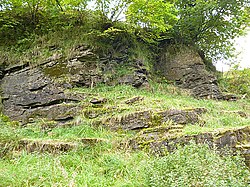
East Kirkton Quarry
East Kirkton Quarry, or simply East Kirkton, is a former limestone quarry in West Lothian, Scotland, now a renowned fossil site. The quarry is known for terrestrial and freshwater fossils up to 341 million years old, from the Viséan stage of the Mississippian subperiod (Early Carboniferous Period). The quarry is a 200-meter-long (~650 ft) depression located in the town of Bathgate. Geographically, it sits at the Bathgate Hills near the center of the Midland Valley, a fossil-rich region of southeast Scotland. The site is dominated by volcanic tuff, limestone, and silica deposits of large freshwater lakes associated with hot springs and local basaltic (high-iron) volcanism. Three geological intervals are exposed: the East Kirkton Limestone (oldest), Little Cliff Shale (middle), and Geikie Tuff (youngest). The East Kirkton Limestone in particular has produced numerous well-preserved fossils of tetrapods (four-limbed vertebrates) and arthropods (multi-legged chitinous invertebrates like millipedes and arachnids). East Kirkton had been ignored by paleontologists since the 1840s, but Scottish fossil collector Stan Wood managed to procure the land in 1985, sparking a rush of scientific interest. New species from East Kirkton have been named on a regular basis since 1990, and nearly all of these species have been found nowhere else. Notable discoveries include Westlothiana (one of the most reptile-like Mississippian tetrapods), Balanerpeton (a common early representative of amphibians in the group Temnospondyli), and Pulmonoscorpius (the largest known terrestrial scorpion). The East Kirkton area represents an unconventional environment: dry woodlands and mineral-rich lakes nestled among volcanic cinder cones. Aquatic animals, though not uncommon, are less diverse than those found in the swampy coal forests and coastal sediments prevalent at other Scottish Carboniferous fossil sites. The prevalence of terrestrial organisms represents a broader trend of decreasing reliance on an amphibious lifestyle during the Carboniferous Period.
Lieux à Proximité Voir Menu

Bathgate
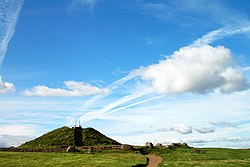
Cairnpapple Hill
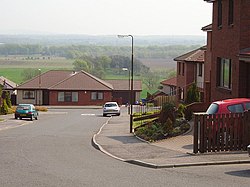
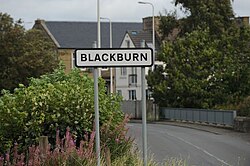
Blackburn (Écosse)
