

 English
 Français

Borders Railway
The Borders Railway connects the city of Edinburgh with Galashiels and Tweedbank in the Scottish Borders. The railway follows most of the alignment of the northern part of the Waverley Route, a former double-track line in southern Scotland and northern England that ran between Edinburgh and Carlisle. That line was controversially closed in 1969, as part of the Beeching cuts, leaving the Borders region without any access to the National Rail network. Following the closure, a campaign to revive the Waverley Route emerged. Discussion on reopening the northern part of the line came to a head during the early 2000s. Following deliberations in the Scottish Parliament, the Waverley Railway (Scotland) Act 2006 received royal assent in June 2006. The project was renamed the "Borders Railway" in August 2008, and building works began in November 2012. Passenger service on the line began on 6 September 2015, whilst an official opening by Queen Elizabeth II took place on 9 September. The railway was rebuilt as a non-electrified, largely single-track line. Several surviving Waverley Route structures, including viaducts and tunnels, were rehabilitated and reused for the reopened railway. Passenger services run half-hourly on weekdays until 20:00, and hourly until 23:54 and on Sundays. The timetable also allows charter train promoters to run special excursion services, and for the weeks following the line opening scheduled steam trains were run.
Lieux à Proximité Voir Menu

Falahill
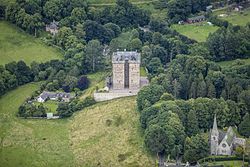
Château de Borthwick


Arniston House
