The South Ferry station was an elevated station at the southern terminal of the IRT Second, Third, Sixth and Ninth Avenue Lines. It was located next to Battery Park at the lower tip of Manhattan, New York City. Two tracks came from the combined Second and Third Avenue Lines, and two from the Sixth and Ninth Avenue Lines, making four tracks at the terminal, with platforms on the outside and between each pair of tracks (no platform in the center). The station was right above access to various ferries at South Ferry, at both the Battery Maritime Building and the Whitehall Terminal. The next stop on the Second and Third Avenue Lines was Hanover Square. The next stop on the Sixth and Ninth Avenue Lines was Battery Place. The first elevated station at South Ferry was opened April 5, 1877 by the New York Elevated Railroad. It had one island platform between two tracks and was operated as an extension of the company's Ninth Avenue Line. The tracks were later continued straight into the company's Third Avenue Line, which opened August 26, 1878. The four-track station, opened March 1879, was built to provide an adequate terminal for both lines. It was located on a very short branch line, at right angles to the old station, facing toward the ferry terminals. Later the Second and Sixth Avenue Lines also used the terminal. A fire at the station in 1919 damaged the Whitehall Street Terminal. Ridership on the Els began to decline as subway stations were replacing them. The Sixth Avenue Line was eliminated from the station in 1938, the Ninth Avenue Line in 1940, and the Second Avenue Line in 1942. When the Third Avenue Line was eliminated in 1950, the station was permanently closed. The station site is currently occupied by the South Ferry subway station.

1. References


1. External links

Media related to South Ferry (IRT elevated station) at Wikimedia Commons

South Ferry Station; Third Avenue El (NYCSubway.org)

Lieux à Proximité Voir Menu
Location Image
80 m

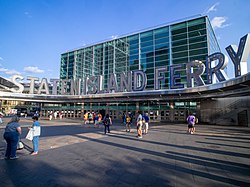
Staten Island Ferry Whitehall Terminal

Le Staten Island Ferry Whitehall Terminal est un terminal du Ferry de Staten Island situé dans le port de New York. Il a été rénové entièrement en février 2005.
Location Image
131 m

South Ferry – Whitehall Street (métro de New York)

South Ferry – Whitehall Street est une station du métro de New York située dans les quartiers Battery Park et Financial District dans le borough de Manhattan. Elle est partagée par l'IRT Broadway - Seventh Avenue Line et la BMT Broadway Line. Le complexe est desservi tout le temps par le train 1, tout le temps sauf tard dans la nuit par le train R et tard dans la nuit par le train N. Initialement non connectées, les deux stations sont reliées entre elles en 2009 après la construction du nouveau terminal de ferry, ce qui permet un transfert gratuit entre les trains de la ligne 1 et des lignes N et R à l'ancienne station Whitehall Street. En 2013, la MTA doit ajouter une connexion à l'ancienne station South Ferry lorsque la nouvelle station est fermée par suite de l'ouragan Sandy. Ce complexe est la troisième station à porter le nom South Ferry. La deuxième, ouverte entre 1905 et 2009, dessert alors l'IRT Broadway - Seventh Avenue Line et la Lexington Aveune Line. La première est une station aérienne qui est ouverte entre 1877 et 1950 et qui dessert alors les anciennes lignes Ninth, Sixth, Third et Second Avenue.
Location Image
149 m

Whitehall Street

Whitehall Street, est une rue de New York.
Location Image
169 m

Battery Maritime Building

Le Battery Maritime Building est un terminal de ferry sur la pointe sud de l'île de Manhattan à New York. Situé au 10 South Street, près de l'intersection avec Whitehall Street, il est utilisé pour des excursions et est utilisé comme terminal de ferry pour Governors Island depuis 1956 . Le bâtiment de style Beaux-Arts a été construit de 1906 à 1909 en tant que jetée municipale du Ferry. Il a été inscrit au registre national des lieux historiques en 1976.
Location Image
173 m

Grand Incendie de New York de 1776

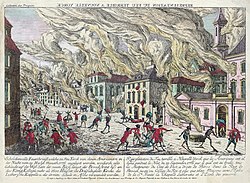
Le Grand Incendie de New York de 1776 est un sinistre qui a détruit une vaste zone allant du côté ouest de la ville jusqu’au sud de l’île de Manhattan dans la nuit du 21 septembre 1776. Il éclate dans les premiers jours de l’occupation militaire de New-York par les forces britanniques pendant la guerre d’indépendance des États-Unis. L'incendie détruit environ 10 à 25 %, voire le tiers de la ville. De surcroît, certaines parties épargnées par le feu sont victimes de pilleurs. Les New Yorkais et les responsables britanniques, qui accusent les rebelles, se soupçonnent mutuellement d’être à l’origine du départ de feu. Ce sinistre a des effets à long terme sur l’occupation britannique de New York, qui ne prend fin qu’avec le Jour de l'Évacuation en 1783.