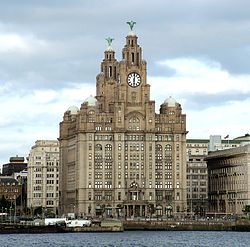
The Fourth Grace was a planned development to be built on the Liverpool Pier Head, as a part of the Liverpool European Capital of Culture 2008 bid. The project name was derived from its location adjacent to the three historic buildings at the Pier Head site, known as "the Three Graces". These are the Port of Liverpool Building, the Cunard Building and the Royal Liver Building. Four proposals were submitted, all of which received criticism for their appearance and contrast to the city's famed historic skyline.

'Fourth Grace Foster' (seen as one of the most likely developments for the site, and named after architects Foster and Partners), comprised a triangular 145 m (476 ft) tower (which would have completely overshadowed the Three Graces), containing some 500 apartments alongside a 100-room 5-star hotel, and a block designed to resemble the hull of a ship extending out over the river. The development would have contained office space and a museum site. 'Fourth Grace Rogers', by the Richard Rogers Partnership, comprised two towers (1 and 2) of 125 m (410 ft) and 94 m (308 ft) respectively, and a mixed-use centre under an undulating roof. 'Fourth Grace 1 Cullinan', proposed by Edward Cullinan Architects, comprised two 135 m (443 ft) mixed use buildings, and a globe-shaped 1000-seat theatre. 'Fourth Grace Towers', a more conceptual design from architect firm Alsop, comprised a Zoomorphic style 118.50 m (389 ft) tower with residential, office and retail space, and a balloon-shaped structure (“the Cloud”) containing the museum site. Public consultation found the Cullinan design to be the favourite, while the Alsop design was the least popular amongst the public and in a survey of architects. Despite this, Alsop's 'Cloud' was the winning entry. However, it was beset with difficulties, and was cancelled in 2004 due to spiralling costs. Currently, it has been relocated to Toronto, Canada, where preliminary construction work is being undertaken. All ideas were eventually scrapped in favour of the Mann Island Development, comprising the new Museum of Liverpool, the Liverpool Canal Link, and three modernist mixed-use private enterprise blocks, the Mann Island Buildings.

Lieux à Proximité Voir Menu
Location Image
85 m

Musée de Liverpool

Le musée de Liverpool, en anglais : Museum of Liverpool, est un musée sur l'histoire locale situé à Liverpool au Royaume-Uni. Créé en 2011, il remplace le Museum of Liverpool Life. La construction du nouveau bâtiment a couté 72 millions de livres.
Location Image
93 m

Port of Liverpool Building

Le Port of Liverpool Building est un bâtiment classé situé à Liverpool, en Angleterre. Il a été construit entre 1903 et 1907 sur Pier Head, aux côtés du Cunard Building et du Royal Liver Building. Il abritait à l'origine la direction des Mersey Docks and Harbour Board (MDHB). Le bâtiment a été conçu par Arnold Thornely and F.B. Hobbs d'un style "Edwardian Baroque".
Location Image
188 m

Cunard Building

Le Cunard Building est un bâtiment classé situé à Liverpool, en Angleterre. Il a été construit entre 1914 et 1916 sur Pier Head, aux côtés du Port of Liverpool Building et du Royal Liver Building. C'est l'ancien siège de la Cunard Line.
Location Image
199 m

Pier Head

Le Pier Head est un ensemble de bâtiments se trouvant sur les rives de la rivière Mersey à Liverpool. Il fait partie du patrimoine mondial de l'UNESCO depuis 2004 à travers la dénomination de « Liverpool – Port marchand ». Le site historique comprend un trio de monuments se trouvant sur ce qui s'appelait le George's Dock qu'on a l'habitude de désigner par The Three Graces, « les trois grâces » : le Royal Liver Building, construit entre 1908 et 1911 par Walter Aubrey Thomas. Il se présente sous la forme de deux tours à horloge, toutes deux couronnées par une statue du Liver bird, symbole de Liverpool. Le bâtiment abrite le siège de la Royal Liver Friendly Society ; le Cunard Building, construit entre 1914 et 1916, c'est l'ancien siège de la Cunard Line ; le Port of Liverpool Building, construit entre 1903 et 1907, il abritait la direction des Mersey Docks. Également classé, le tunnel du Mersey, à l'est des monuments, fut construit dans les années 1930 et contient les bureaux ainsi que la ventilation du tunnel de Queensway. De nombreux projets de réaménagement du site ont été imaginés. En 2002 le projet Fourth Grace, « quatrième grâce », imaginé par Wil Alsop et connu sous le nom de the Cloud, « le nuage », fut commencé avant d'être abandonné en 2004 à cause de son coût. En 2007 ont commencé des travaux pour déplacer le Museum of Liverpool Life. La même année, la construction du Liverpool Canal Link a démarré, long de 1,6 mile (2,6 km), il doit relier le Leeds-Liverpool Canal au South Docks.
Location Image
270 m

Royal Liver Building

Le Royal Liver Building est un bâtiment classé, haut de 103 m, l'un des premiers au monde réalisés en béton armé, situé à Liverpool, en Angleterre. Il a été construit entre 1908 et 1911 par Walter Aubrey Thomas sur Pier Head, aux côtés du Cunard Building et du Port of Liverpool Building. Il se présente sous la forme de deux tours horloge, toutes deux couronnées par une statue du Liver bird, symbole de la ville. Le bâtiment abrite le siège de la Royal Liver Friendly Society.