

 English
 Français
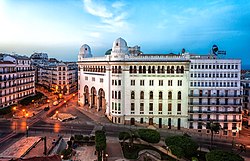
Grande Poste d'Alger
The Algiers Central Post Office, (Arabic: بريد الجزائر المركزي, French: Grande Poste d'Alger) is a masterpiece of Neo-Moorish (or Jonnasrt) architecture and one of Algeria's most famous landmarks. Situated at the intersection of Boulevard Mohamed-Khemisti and Rue Larbi Ben M'hidi in the center of Algiers, it represents the city's intricate colonial past as well as its architectural development.
1. History
Built in 1910 on the site of an old Turkish fort and an Anglican church, the structure was commissioned by the French colonial government. Architects Marius Toudoire and Jules Voinot created the design. Charles Jonnart, the Governor-General of Algeria at the time, supported a larger architectural policy that included this design. The goal of this Neo-Moorish style was to promote cultural harmony by fusing traditional Andalusian and North African aesthetics with French administrative requirements.
Construction began in 1910 and was finished sometime in 1913. Capacity: It could accommodate 9,000 people a day on average when it was operating as a post office. Transition: In order to start transforming the building into a Museum of Post and Telecommunications, the government relocated postal services in 2014–2015.
1. Architectural Features
The structure is praised for its complex blend of Islamic ornamental arts and European structural methods.
Exterior Facade: The three enormous, horseshoe-shaped arches at the main entrance are held up by twin columns. Minaret-like Towers: The structure has ornamental towers on either side that resemble Maghrebi minarets. Inscriptions: The names of the main Algerian cities are listed in Arabic calligraphy on green earthenware tiles that adorn a metal balustrade along the roof. Staircase: The main entrance is reached by a massive amber-colored marble staircase. Interior Central Dome: Reminiscent of Spain's Alhambra, the interior is dominated by a towering octagonal dome with radiating geometric interlacing. Ornamentation: The walls are adorned with elaborate mosaics, carved woodwork, and "stalactite" stucco (muqarnas). Decorated Post Box: There is a renownedly elaborate post box close to the entrance that is frequently regarded as one of the most exquisite in the world.
1. Cultural Significance
The Grande Poste serves as a hub for Algerian public life in addition to being a useful structure.
Revolutionary Symbol: The square in front of the post office served as a major hub for nonviolent protesters during the 2019–2020 Hirak protests. Museum Transition: Since reopening as a museum in 2018, it has been showcasing the history of Algerian telecommunications and philately (stamps), tracing the country's development from colonialism to independence.
1. Image Gallery


1. See also
Algérie Poste
1. References
Lieux à Proximité Voir Menu
Grande Poste d'Alger

Boulevard Mohamed-Khemisti

Square Sofia

Institut français d'Algérie
