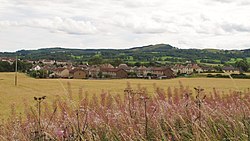
Linlithgow ( lin-LITH-goh; Scots: Lithgae; Scottish Gaelic: Gleann Iucha) is a town in West Lothian, Scotland. It was historically West Lothian's county town, reflected in the county's historical name of Linlithgowshire. An ancient town, it lies in the Central Belt on a historic route between Edinburgh and Falkirk beside Linlithgow Loch. The town is situated approximately 20 miles (32 km) west of Edinburgh. During the medieval period, the town grew in prominence as a royal burgh and residence around Linlithgow Palace. In later centuries, Linlithgow became a centre of industry in leather making and other materials, before developing rapidly in the Victorian era with the opening of the Union Canal in the 1820s and the arrival of the railway in 1842. Linlithgow was the former county town of the county but the Council now resides in nearby Livingston. Today Linlithgow has less industry and the economy of the town centre is focused on hospitality, heritage and tourism services. Linlithgow's patron saint is Saint Michael and its motto is St. Michael is kind to strangers. A statue of the saint holding the burgh coat of arms stands on the High Street. In 2019, the population of the Linlithgow ward (which includes the town and greater area) was 16,499.

Lieux à Proximité Voir Menu
Location Image
0 m

Linlithgow

Linlithgow (gaélique écossais : Gleann Iucha, Scots : Lithgae) est un burgh royal du West Lothian, en Écosse. Il est situé à une trentaine de kilomètres à l'ouest d'Édimbourg et compte 13 370 habitants. Son symbole est un chien noir enchaîné à un chêne poussant sur une île. Son saint patron est Saint Michel et sa devise est « St. Michael is kind to strangers » (Saint Michel est bienveillant pour les étrangers). Il est jumelé avec la ville française de Guyancourt et, en tant que partie du West Lothian, avec Grapevine (Texas), aux États-Unis[réf. souhaitée].
Location Image
590 m

Palais de Linlithgow

Le palais de Linlithgow est une ancienne résidence royale d'Écosse, située à Linlithgow, dans le West Lothian, à environ 25 km à l'ouest d'Édimbourg. Partiellement détruit au XVIIIe siècle lors de la guerre entre les partisans des Stuarts et le duc de Cumberland, il fait aujourd'hui partie des monuments nationaux de Grande-Bretagne.
Location Image
1.3 km

Donaldson's School

La Donaldson's School est l'école nationale écossaise pour les sourds. Située à l'origine à Édimbourg, elle a déménagé vers un nouvel emplacement à Linlithgow en 2008. Il s'agit d'un pensionnat et d'un externat qui propose un enseignement, une thérapie et des soins aux élèves sourds ou ayant des difficultés de communication.
2.8 km

Diocèse d'Édimbourg

Le diocèse d'Édimbourg est au Royaume-Uni, un diocèse de l'Église épiscopalienne écossaise. C'est le seul qui a été créé après la Réforme par le roi Charles Ier en 1634. La cathédrale diocésaine est celle de Sainte-Marie d'Édimbourg. Autres églises notables du diocèse : Église Saint-Paul et Saint-Georges d'Édimbourg Chapelle de Rosslyn Portail du protestantisme Portail de l’Écosse Portail de l'anglicanisme
Location Image
2.9 km

Whitecross (Falkirk)

Whitecross est un village dans le Falkirk, en Écosse.