Masbrough Independent Chapel

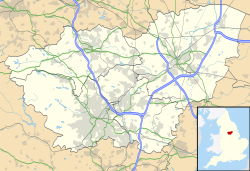
The Masbrough Independent Chapel (also known as Masbro Independent Chapel, Masbrough Chapel and Masbro Chapel) was an Independent or Congregationalist chapel in the Masbrough district of Rotherham, from the 18th century until the 1970s, at which point it became part of the United Reformed Church. The chapel remained part of the United Reformed Church until its closure as a place of worship towards the end of the 20th century. The chapel's congregation merged with the Greasbrough congregation of the United Reformed Church and then, in 2003, with the Greasbrough Methodist congregation to form a local ecumenical partnership using the name Greasbrough United Church. The former chapel building was Listed as a building of special historical or architectural interest. After it was no longer used as a place of worship, it found a new use as a carpet warehouse. The building suffered two serious fires in 2012, and it was demolished in December 2012. The chapel was closely associated with the Walker family who were leading industrialists in Rotherham. The Walker Mausoleum stands in the chapel's burial ground and the Mausoleum is itself a Listed building. The chapel was also closely associated with the Rotherham Independent Academy, a training school for ministers, founded in 1795. Later in the 19th century, the Academy moved from Masbrough to new premises built in "collegiate gothic" style on Moorgate Road, Rotherham.

The Moorgate Road premises are now occupied by the Thomas Rotherham College. In 1795, Dr Edward Williams took the pastorate at the chapel and also became the first theological tutor at the then newly formed Rotherham Independent Academy which was built nearby. Joshua and Thomas Walker were generous benefactors to the Academy. Williams had been one of those involved in the formation in 1794 of the missionary society that was later named London Missionary Society. Williams preached the charge to the first missionaries sent out by the society. During the ministry of the Reverend Thomas Nicholson (served 1879–1900) the worshipping congregation grew from 225 to 530. During the Depression of the 1920s and 30s, the congregation organized the construction of a bowling green on land near the chapel by un-employed men, for their recreational enjoyment, and classes in boot repair and other things were held to help them through the Depression. During the 1950s, the chapel's minister Cyril Grant provided ministerial oversight for the formation and development of a new church at Herringthorpe, the church that is now the Herringthorpe United Reformed Church. This work first started in hired rooms at the Herringthorpe Junior School, later moving into its own purpose-built premises on Wickersley Road, adjacent to the Stag Inn.

Lieux à Proximité Voir Menu
Location Image
464 m

New York Stadium

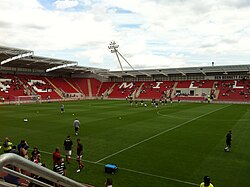
Le New York Stadium est un stade de football anglais situé à Rotherham dans le Yorkshire du Sud. C'est le stade du club de troisième division Rotherham United.
Location Image
537 m

Masbrough

Masbrough est une banlieue de Rotherham, dans le Yorkshire du Sud, en Angleterre. Cette banlieue (brough) située à l'ouest de Rotherham et sur la rive gauche de Don prit son nom au milieu de la révolution industrielle. Faisant historiquement partie de la West Riding of Yorkshire, Masbrough se trouve dans le District métropolitain de Rotherham, au centre-ville à 0,8 km à l'ouest du centre-ville de Rotherham. Une partie de ses terres au nord se trouve aujourd'hui dans le manoir de Kimberworth, l'autre banlieue ouest de Rotherham (on notera que Masbrough n'a été citée dans l'étude Domesday Book de 1086).
Location Image
681 m

District métropolitain de Rotherham

Le district métropolitain de Rotherham (Metropolitan Borough of Rotherham en anglais) est un district métropolitain du Yorkshire du Sud, en Angleterre. Il porte le nom de sa principale ville, Rotherham, et comprend également les villes de Maltby, Rawmarsh, Swinton et Wath-upon-Dearne.
Location Image
1.5 km

Rotherham

Rotherham est une ville du Royaume-Uni, située dans le nord-est de l'Angleterre, appartenant au comté de Yorkshire. Elle compte 255 000 habitants (agglomération comprise, chiffres de 1997), ce qui la place au 26e rang des agglomérations anglaises. Depuis les années 1980, elle est le théâtre de l'affaire des viols collectifs de Rotherham. Rotherham a un passé important en tant que ville charbonnière ainsi que comme un contributeur majeur à l'industrie sidérurgique. Les industries traditionnelles comprenaient la fabrication du verre et la minoterie. La région environnant Rotherham est de nature plutôt urbaine, au relief doux, principalement constituée de collines peu élevées.
Location Image
2.0 km

Magna Science Adventure Centre

Le Magna Science Adventure Centre est un musée pédagogique principalement destiné aux enfants, situé dans le district de Templeborough (en) à Rotherham, en Angleterre. Il ouvre en avril 2001 dans les locaux de l'ancienne aciérie de Steel, Peech and Tozer (en). Les principales expositions sont réparties en quatre pavillons : la Terre, l'Air, le Feu et l'Eau. Le musée possède une aire de jeux extérieure appelée Sci-Tek et une aire de jeux aquatique appelée Aqua-Tek. Le site, long d'environ 500 m et haut de neuf étages, est souvent utilisé pour des mises en scène, des conférences et des concerts. Il accueille en moyenne 120 000 visiteurs par an. En 2006, le musée remporte le Enjoy England Gold Award for Business Tourism. Toutes les heures, l'attraction « The Big Melt » (« La Grande Fonte ») montre aux visiteurs le procédé de fabrication de l'acier dans le four à arc électrique de l'ancienne usine jusqu'à sa fermeture en 1993. En 2001, le Magna Science Adventure Centre reçoit le prix Stirling RIBA pour la reconversion innovante de l'espace de l'ancienne aciérie par les architectes Wilkinson Eyre, Mott MacDonald et Buro Happold. En l'an 50 ap. J.-C., ce lieu accueillait un camp romain.