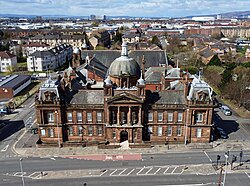
Govan ( GUV-ən; Cumbric: Gwovan; Scots: Gouan; Scottish Gaelic: Baile a' Ghobhainn) is a district, parish, and former burgh now part of southwest Glasgow, Scotland. It is situated 2+1⁄2 miles (4 kilometres) west of Glasgow city centre, on the south bank of the River Clyde, opposite the mouth of the River Kelvin and the district of Partick. Historically it was part of the County of Lanark. In the early medieval period, the site of the present Govan Old churchyard was established as a Christian centre for the Brittonic Kingdom of Alt Clut (Dumbarton Rock) and its successor realm, the Kingdom of Strathclyde. This latter kingdom, established in the aftermath of the Viking siege and capture of Alt Clut by Vikings from Dublin in 870, created the stone sculptures known today as the Govan Stones. Govan was the site of a ford and later a ferry which linked the area with Partick for seasonal cattle drovers. In the eighteenth and nineteenth centuries, textile mills and coal mining were important; in the early-nineteenth century, shipbuilding emerged as Govan's principal industry. In 1864, Govan gained burgh status, and was the fifth-largest burgh in Scotland. It was incorporated into the City of Glasgow in 1912.

Lieux à Proximité Voir Menu
0 m

Govan (Glasgow)

Govan (scots : Gouan, gaélique écossais : Baile a' Ghobhainn) est un ancien burgh, aujourd'hui un district de Glasgow en Écosse, intégré à la ville depuis 1912. Un de ses anciens quartiers, Linthouse, en avait été détaché onze ans auparavant pour devenir un district de Glasgow dès 1901. Il est situé à 4 kilomètres à l'ouest du centre-ville, au sud de la Clyde. De 1834 à 1968, le quartier a hébergé l'un des plus grands chantiers navals du pays, la Fairfield Shipbuilding and Engineering Company.
Location Image
418 m

Riverside Museum

Le Riverside Museum, musée écossais des transports, a été officiellement inauguré le 21 juin 2011 à Glasgow. Le musée, conçu par Zaha Hadid, a reçu le Prix du musée européen de l'année 2013 par le Forum Européen du Musée.
Location Image
818 m

Kelvin (rivière)

La Kelvin est une rivière d'Écosse et un affluent de la Clyde.
917 m

Ibrox Park (1887-1899)

Ibrox Park était un terrain de football situé à Glasgow, dans le quartier d'Ibrox, en Écosse. C'était le terrain d'origine des Rangers de 1887 jusqu'à ce qu'ils déménagent dans le deuxième Ibrox Park adjacent en 1899. Le terrain a accueilli quatre fois la finale de la Coupe d'Écosse de football et trois matchs internationaux de l'équipe d'Écosse de football.
Location Image
924 m

Ibrox Stadium

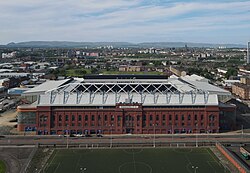
Ibrox Stadium, appelé à l'origine Ibrox Park, est un stade de football situé à Glasgow, dans le quartier d'Ibrox, sur la rive sud de la Clyde. Le club des Glasgow Rangers y réside depuis 1899.