
Manchester Institute of Innovation Research (MIoIR) is a research institute based in Alliance Manchester Business School at the University of Manchester, UK. MIoIR is a centre of excellence in the fields of innovation studies, technology management and innovation management, science policy, technology policy, innovation policy and regional innovation, the study of emerging technologies (or em tech), responsible research and innovation, and research into socio-technical transitions with a focus on sustainability and digital transitions. MIoIR has also been known for research on service innovation and in particular the definition and early exploration of the concept of knowledge-intensive business services, through the work of scholars such as Ian Miles and Bruce Tether. The Institute consists of a group of internationally renowned scholars and experts, with more than 50 full members, approximately 30 PhD researchers, and a range of associated academics. Since the 1970s the institute and its predecessor bodies have contributed to the national and international debate about science policy and innovation (as noted in connection with UK debates by Agar) and helped develop the field of research evaluation and formulating the now widely used concept of behavioural additionality.

The Institute is currently housed in the newly refurbished Alliance Manchester Business School building on the corner of Oxford Road and Booth Street West, Manchester. For many of its earlier years it was based with the now-demolished Mathematics Tower of the University of Manchester. A number of the current members of MIoIR are also co-investigators of, or otherwise affiliated with, the ESRC-funded Productivity Institute, a national virtual institute with its headquarters at Manchester.

Lieux à Proximité Voir Menu
Location Image
59 m

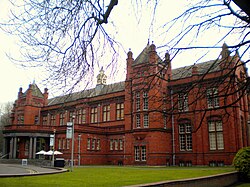
Whitworth Art Gallery

La Whitworth Art Gallery est une galerie d'art de Manchester, en Angleterre, qui contient 55 000 objets dans sa collection. Le musée est situé au Sud du campus de l'université de Manchester à Whitworth Park. Il a été fondé par Robert Darbishire grâce à un don de Sir Joseph Whitworth en 1889, sous le nom de The Whitworth Institute and Park. Le premier bâtiment fut terminé en 1908. En 1958 la galerie est rattachée à l'université de Manchester. En 1974, le bâtiment de la Whitworth Art Gallery est classé Grade II. En octobre 1995, une nouvelle galerie est ouverte dans une mezzanine au centre du bâtiment, bien adaptée pour présenter des sculptures. En 2010, la galerie accueille 172 000 visiteurs, ce qui en fait une des dix attractions touristiques les plus visitées du Grand Manchester.
Location Image
228 m

Whitworth Park

Whitworth Park est un parc public, localisé au sud de Manchester en Angleterre. Il est juxtaposé à la Whitworth Art Gallery, le musée d’Art moderne et contemporain de la ville. Whitworth Park se situe dans le quartier universitaire. Au nord se trouvent les résidences étudiantes de l'Université de Manchester, appelées Toblerones. Historiquement, le parc était sous la gestion de Chorlton-on-Medlock, un autre quartier de Manchester. Désormais[Quand ?], Whitworth Park est rattaché à la localité de Moss Side. Le parc de quelque 18 acres (7,3 ha), se situe en face de l’hôpital universitaire de Manchester, Manchester Royal Infirmary, et a été inauguré en 1890 sur un terrain appelé Potters Field. En octobre 1904 et en vertu d'un bail de 1000 ans moyennant un loyer annuel nominal de 10 £, les administrateurs de Whitworth Park louèrent le terrain à la Corporation of Manchester. Une statue du roi Édouard VII, réalisée par John Cassidy, a été inaugurée en 1913 du côté est du parc. Elle commémore la visite royale lors de l'inauguration de l’hôpital Manchester Royal Infirmary en 1909. La statue en bronze, montée sur un socle en granit brut à forme carrée, est une classée au grade II. Le parc est un lieu de rencontre pour étudiants et famille vivant aux alentours du parc.
Location Image
267 m

Manchester Royal Infirmary

Le Manchester Royal Infirmary (MRI) est un centre hospitalier situé à Manchester, en Angleterre qui a été fondé en 1752 par Charles White sous la forme d'un hôpital rural pouvant s'occuper de douze patients. Le Manchester Royal Infirmary fait partie d'un ensemble plus important, le NHS Trust qui comprend plusieurs hôpitaux regroupés au sein du Central Manchester University Hospitals NHS Foundation Trust. Il s'agit d'un Centre hospitalier universitaire dépendant de l'école de Médecin de l'Université de Manchester. les autres centre hospitaliers universitaires membres du NHS trust sont: St Mary's Hospital (fondé en 1790), le Manchester Royal Eye Hospital (1814), le University Dental Hospital of Manchester (1884) et le Royal Manchester Children's Hospital (1829).
Location Image
292 m

Contact Theatre

Contact est une salle de Manchester destinée à accueillir toute sorte d'évènements. Il s'agissait à l'origine d'un théâtre mais depuis 1999 elle a été modifiée pour recevoir divers évènements, notamment pour les jeunes.
Location Image
338 m

Manchester Academy

Manchester Academy est le nom par lequel l'union des étudiants de l'université de Manchester désigne ses quatre salles de spectacle à Manchester, en Angleterre, sur Oxford Road. 'Manchester Academy' désignait à l'origine la plus importante de ces quatre salles, mais dans les années 2000 on a utilisé ce terme pour désigner l'ensemble des salles. Ces salles ont notamment accueilli Ian Brown, Biffy Clyro, The Stranglers, Super Furry Animals, You Me At Six, Billy Talent, Pink Floyd, Owl City, David Bowie, The Cure, The Coral, Blur, Oasis, John Butler Trio, George Clinton, Nirvana, Wolfmother, Manic Street Preachers, The Libertines, The Ramones, Death Cab for Cutie, Supergrass, Katy Perry, Lady Gaga, Marilyn Manson, Prodigy et Slash, parmi d'autres.