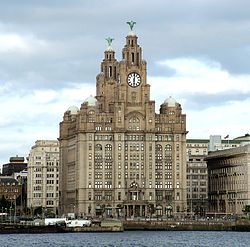
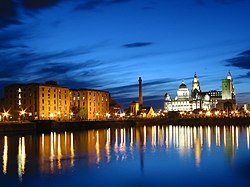
The Port of Liverpool is the enclosed 7.5-mile (12.1 km) dock system that runs from Brunswick Dock in Liverpool to Seaforth Dock, Seaforth, on the east side of the River Mersey and the Birkenhead Docks between Birkenhead and Wallasey on the west side of the river. In 2023, the Port of Liverpool was the UK’s fourth busiest container port, handling around 900,000 TEUs of cargo each year, equivalent to over 30 million tonnes of freight per annum. It handles a wide variety of cargo, including containers, bulk cargoes such as coal, grain and animal feed, and roll-on/roll-off cargoes such as cars, trucks and recycled metals. The port is also home to one of the largest cruise terminals in the UK which handles approximately 200,000 passengers and over 100 cruise ships each year. The port has significant links to North America and the rest of Europe via the Irish Sea and Atlantic Ocean. It is the most significant port in the UK for transatlantic trade. The port's history spans over 800 years and at its peak in the 19th century, it was the second most important port in the British Empire. In 2016, the port was extended by the building of an in-river container terminal at Seaforth Dock, named Liverpool2. The terminal can berth two 14,000 container Post-Panamax ships. Garston Docks, which are in the city of Liverpool, are not a part of the Port of Liverpool. The working docks are operated by Mersey Docks and Harbour Company, while the docks to the south of the Pier Head are operated by the Canal & River Trust, the successor to former operator British Waterways.

Lieux à Proximité Voir Menu
Location Image
0 m

Port de Liverpool

Le port de Liverpool est un vaste complexe portuaire rassemblant des installations allant du dock de Brunswick à Liverpool au dock de Seaforth à Seaforth, situées sur les rives Est du fleuve Mersey, et les docks de Birkenhead situés sur la rive Ouest du fleuve entre Birkenhead et Wallasey. Les quais opérationnels sont exploités par la Mersey Docks and Harbour Company (en), les quais situés au sud de Pier Head, par Canal & River Trust, successeur de British Waterways.
Location Image
26 m

Royal Liver Building

Le Royal Liver Building est un bâtiment classé, haut de 103 m, l'un des premiers au monde réalisés en béton armé, situé à Liverpool, en Angleterre. Il a été construit entre 1908 et 1911 par Walter Aubrey Thomas sur Pier Head, aux côtés du Cunard Building et du Port of Liverpool Building. Il se présente sous la forme de deux tours horloge, toutes deux couronnées par une statue du Liver bird, symbole de la ville. Le bâtiment abrite le siège de la Royal Liver Friendly Society.
Location Image
108 m

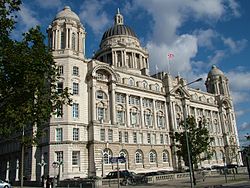
Cunard Building

Le Cunard Building est un bâtiment classé situé à Liverpool, en Angleterre. Il a été construit entre 1914 et 1916 sur Pier Head, aux côtés du Port of Liverpool Building et du Royal Liver Building. C'est l'ancien siège de la Cunard Line.
Location Image
130 m

Port marchand de Liverpool

Le port marchand de Liverpool est un ancien site britannique classé du patrimoine mondial de l'Unesco. Il comprenait six zones distinctes situées dans le centre de la ville de Liverpool (Pier Head, Royal Albert Dock, Stanley Dock, Duke Street, Castle Street et William Brown Street) qui correspondaient aux quartiers commerciaux développés à partir du XVIIIe siècle. Plusieurs bâtiments emblématiques de la ville s'y trouvent, dont le Royal Liver Building, le Port of Liverpool Building et le Cunard Building.
Location Image
140 m

Memorial to the Engine Room Heroes of the Titanic

Le Memorial to the Engine Room Heroes of the « Titanic » (« Mémorial aux héros de salle des machines du Titanic ») est un mémorial dédié aux opérateurs qui sont restés à leur poste en salle des machines pendant le naufrage du Titanic. Il est situé sur la St. Nicholas Place de Pier Head, à Liverpool, en Angleterre. Le RMS Titanic était propriété par la White Star Line qui a été fondée à Liverpool en 1840. Le monument de granite a été conçu par Goscombe John et construit vers 1916.