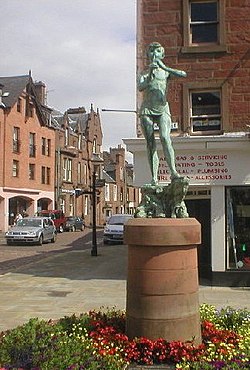
Airlie (Scottish Gaelic: Iarlaidh) is a civil parish in the Scottish council area of Angus. It is the seat of the Earl of Airlie, and the location of Airlie Castle. It comprises Craigton of Airlie, Baitland of Airlie and Kirkton of Airlie. There is a standing stone in a field just east of the Baitland; various Pictish and Roman relics (stone coffins etc.) have been uncovered and the primary school is reputed to have been built on the site of an old graveyard. Airlie also contains one of the finest examples of a Pictish souterrain in Scotland, with the carving of a snake clearly visible in the ceiling.

Airlie Castle is not currently open to the public, however it is remembered in the song The Bonnie Hoose o' Airlie which is mentioned in Robert Louis Stevenson's novel Kidnapped. The song commemorates the burning of the castle (some of the stonework is still black) by the Earl of Argyll, claiming to act on behalf of the anti-royalists, while the earl was away fighting for the Jacobite cause. However, it is also claimed that Forter Castle in Glen Isla was the "bonnie hoose" destroyed in 1640. It is also mentioned in the song Wha'll be King but Charlie?, as performed by The Corries, presumably because it is a good rhyme for "Chairlie".

Lieux à Proximité Voir Menu
Location Image
7.2 km

Alyth

Alyth est une ville située dans le Perth and Kinross, en Écosse. En 2020 la population de Alyth est estimée à 3 046 habitants.
Location Image
7.7 km

Kirriemuir

Kirriemuir est une localité d'Écosse (ancien burgh créé par Jacques II) située dans le comté d'Angus.
Location Image
7.9 km

Château de Balintore

Le château de Balintore est un bâtiment classé de catégorie A de l'époque victorienne en Écosse.
Location Image
8.1 km

Château de Glamis

Le château de Glamis se trouve à côté du village de Glamis (prononcer [ɡlɑːmz]) dans la zone administrative écossaise de l'Angus. C'est le siège des comtes de Strathmore et Kinghorne, et il est accessible au public. Le château se trouve sur les billets de dix livres émis par la Royal Bank of Scotland. Les plâtres des plafonds de Glamis sont remarquables par leur détail et leur préservation. Le bâtiment central, en forme de L, date du XIVe siècle. Il a été modifié, et au long des siècles on y a ajouté d'autres bâtiments, ce qui donne à l'édifice actuel son apparence impressionnante. Avec ceux du château de Muchalls et du château de Craigievar, ils sont considérés comme les plus beaux d'Écosse. On trouve souvent le château dans des œuvres de fiction et des légendes ; d'après les histoires locales, il y aurait plus de sombres secrets à Glamis que dans tout autre château d'Écosse.
Location Image
8.7 km

Glamis

Glamis (prononcer [Glamz], /ɡlɑːmz/) est un petit village de la zone administrative écossaise de l'Angus.