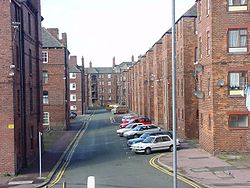
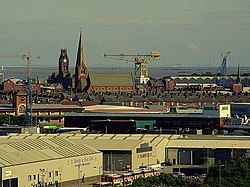
Barrow-in-Furness, commonly known as Barrow, is an industrial port town and civil parish in Westmorland and Furness, Cumbria, England. Historically in Lancashire, Barrow is at the tip of the Furness peninsula, 24 miles (39 km) south-west of Kendal and 18 miles (29 km) west of Lancaster. It is bordered by Morecambe Bay to the east, the Duddon Estuary to the west, and the Irish Sea to the south. In 2021, Barrow's population was 55,489, making it the second largest urban area in Cumbria after Carlisle and the largest in Westmorland and Furness. In the Middle Ages, Barrow was a small hamlet, with its economy controlled by Furness Abbey. In the 19th century, iron prospector Henry Schneider among other investors opened the Furness Railway to transport iron ore and slate from local mines to the coast, which led to the construction of docks, now the Royal Port of Barrow. The discovery of hematite deposits allowed the steel industry to develop in the town, and for a period, its steelworks were the largest in the world. It was incorporated as a municipal borough in 1867, and the town’s steel production and coastal location enabled it to develop as a centre for shipbuilding. The steel industry declined after World War II. Barrow served as the centre of the Borough of Barrow-in-Furness from 1974 until 2023, when the borough was abolished and a parish council established. Barrow is one of England's few planned towns and has a high level of heritage assets compared nationally. Natives of Barrow, as well as the local dialect, are known as Barrovian. Its economy remains dominated by the defence sector, although defence spending cuts since the end of the Cold War have increased unemployment in the town. As of 2025, the BAE Systems shipyard is the largest in the UK by workforce; it has produced Royal Navy flagships, nuclear submarines and other naval and commercial vessels. The town is a hub for energy generation and handling, particularly offshore wind farms.

Lieux à Proximité Voir Menu
Location Image
0 m

Barrow-in-Furness

Barrow-in-Furness est une ville portuaire et industrielle de Cumbria, située dans le nord-ouest de l'Angleterre au Royaume-Uni. En 2011, Barrow-in-Furness avait une population de 55 489 habitants.
Location Image
159 m

Barrow-in-Furness (district)

Barrow-in-Furness était un district non métropolitain de Cumbria, en Angleterre. Il avait le statut de borough. Barrow-in-Furness a été intégrée dans une nouvelle entité administrative. Aujourd'hui, maintenat cette zone fait partie du district unitaire de Westmorland and Furness, résultant d'une réorganisation territoriale visant à améliorer la gestion locale. Il portait le nom de sa principale ville, Barrow-in-Furness. Les autres principales villes du district sont Dalton-in-Furness, Roose et Askam-in-Furness. C'est le plus petit district du comté, et le plus densément peuplé. Le district etait créé le 1er avril 1974. Il etait issu de la fusion de l'ancien borough de Barrow-in-Furness et du district urbain de Dalton-in-Furness.
Location Image
949 m

Barrow (île)

L'île Barrow est une ancienne île de la ville de Barrow-in-Furness, dans le comté de Cumbria en Angleterre. Originellement séparée de la Grande-Bretagne, elle a été reliée au continent en 1860. Elle est séparée de l'île de Walney par le détroit de Walney.
Location Image
1.2 km

Pont de Walney

Le pont de Walney (en anglais : Walney Bridge), officiellement nommé Jubilee Bridge, est un pont basculant situé à Barrow-in-Furness, Cumbria, en Angleterre. Achevé en 1908, il enjambe le chenal Walney, et relie l’île Barrow à l’île Walney. La route nationale A590, qui a son terminus ouest sur Walney, passe sur le pont.
Location Image
1.3 km

Chenal Walney

Le chenal Walney (en anglais : Walney Channel) sépare l’île Walney du continent britannique. La partie nord du chenal s’ouvre sur l’estuaire du Duddon. Elle est à la fois la plus étroite et la moins profonde. La moitié sud du chenal est plus large, et elle est régulièrement draguée pour permettre aux navires d’accéder au port de Barrow-in-Furness. Cette moitié s’ouvre sur la baie de Morecambe. Le chenal est enjambé par le pont de Walney (officiellement Jubilee Bridge) achevé en 1908. En raison des besoins de la navigation, en particulier des activités du chantier naval Vickers, il a été construit comme un pont basculant.