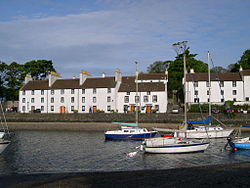
Cramond Tower is a fifteenth-century tower house in the village of Cramond to the north-west of Edinburgh, Scotland.

1. History

The area around the Tower has had a human settlement since the time of Ancient Rome, and there are relics from that time in the area. The Tower was probably built in the late 15th or early 16th century, primarily as a defensive feature, although it could have been built earlier, and may have been mentioned in 1409. It was at one stage part of the bishop of Dunkeld's summer residence. It became the property of James Inglis, an Edinburgh merchant, in 1622. He repurposed the tower to make it more comfortable for occupation, adding and enlarging windows and creating internal recesses to increase the available living space. His grandson moved to the nearby Cramond House in 1680, and the tower was abandoned for the next 300 years. It was portrayed as a romantic ruin by James Skene in 1837, and was in a poor state of preservation by the middle of the twentieth century. In the 1960s, the City of Edinburgh Council put a concrete cap on the roof and cleared the vegetation. In 1978, it was acquired by Eric Jamieson, an amateur antiquarian. Between 1979 and 1981, it was restored by architects Robert Hurd & Partners into a private residence. It was damaged by a fire in 2011.

1. Description

The castle is a nearly square four-storey tower house, around 25 feet (7.6 m) on each side and with walls up to 5 feet (1.5 m) thick. In the south-east corner is a round staircase that protrudes from the building. Currently, the tower has a store at ground level, a living room on the first floor, kitchen on the second, and bedrooms and bathrooms on the third and fourth floors. A pitched roof has been re-erected as part of the restoration. In the 1990s, a stone extension was added on the east side. It is a category B listed building.

1. Archaeology

Excavations between 1976 & 1981 and 1987 & 1988 found medieval and post-medieval material. They also identified building foundations to the west of the tower which are believed to be the outbuildings identified in the 19th century. Because of its proximity to Cramond Roman Fort some Roman amphorae and mortaria, as well as a defensive ditch for the fort, were also found.

1. References


1. External links
Lieux à Proximité Voir Menu
Location Image
54 m

Cramond Kirk

Cramond Kirk est une église située dans le bourg de Cramond au nord-ouest d'Édimbourg, en Écosse. Construit sur le site d'un ancien fort romain, certaines parties de la Cramond Kirk datent du XIVe siècle et le clocher de l'église est considéré comme la partie la plus ancienne.
Location Image
1.1 km

Cramond (Édimbourg)

Cramond est un village écossais situé sur la rive orientale de la rivière Almond, à l'endroit où cette dernière rejoint le Firth of Forth, formant ainsi un port naturel. Cramond est aujourd'hui un faubourg d'Édimbourg. Des fouilles archéologiques ont permis d'y mettre au jour des vestiges romains mais surtout ce qui est à ce jour la plus ancienne implantation humaine en Écosse.
Location Image
1.4 km

Château de Lauriston

Le château de Lauriston est une maison-tour du XVIe siècle à Édimbourg en Écosse, surplombant le Firth of Forth. Le vaste terrain, Lauriston Castle Gardens, est un parc local. Le château a été légué à la Société d’Édimbourg (après 1975, connue sous le nom de Conseil municipal d’Édimbourg) et accueille la Garden Party annuelle du Lord Provost d'Édimbourg. La maison est un bâtiment classé de catégorie A et le jardin est inclus dans l’inventaire des jardins et des paysages d'Écosse.
Location Image
1.9 km

Cramond (Écosse)

L'île de Cramond (Cramond Island) est l'une des nombreuses îles qui émergent du Firth of Forth, sur la côte est de l'Écosse, non loin d'Édimbourg. Comme son nom l'indique, elle se trouve à proximité du village de Cramond. L'île de Cramond s'étend sur une longueur de 500 mètres et couvre une superficie de 19 ares. On considère généralement qu'elle fait partie du domaine de Dalmeny. Strictement parlant, Cramond n'est pas une île, car elle est accessible à marée basse, par le moyen d'une longue chaussée. Ceci favorise les visiteurs qui désirent se rendre sur l'île. Cramond se trouve à un peu plus d'un kilomètre de la côte, information dont il faut tenir compte lorsqu'on désire entreprendre le passage, dans la mesure où la marée survient rapidement. On peut considérer que l'île fait aussi partie de l'estuaire de l'Almond (en), une rivière dont l'embouchure se trouve à proximité de la chaussée de Cramond.
Location Image
2.5 km

Dalmeny House

Dalmeny House (prononcé /d æ l ˈ m ɛ n i /) est un manoir de style néo-gothique situé dans un domaine proche de Dalmeny sur le Firth of Forth, au nord-ouest d'Édimbourg, en Écosse. Il est conçu par William Wilkins et achevé en 1817. Dalmeny House est la demeure du comte et de la comtesse de Rosebery. La maison est la première en Écosse à être construite dans le style néo-Tudor. Elle offre plus de confort que l'ancienne résidence ancestrale, le château de Barnbougle (en), qui se trouve toujours à proximité. Dalmeny reste aujourd'hui une maison privée, bien qu'elle soit ouverte au public pendant les mois d'été. La maison est protégée en tant que bâtiment classé de catégorie A tandis que le terrain est dans l'Inventaire des jardins et des paysages aménagés en Écosse.