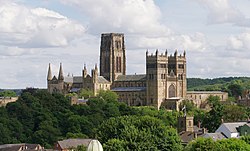
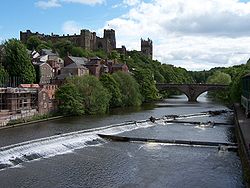
Durham Cathedral, formally the Cathedral Church of Christ, Blessed Mary the Virgin and St Cuthbert of Durham, is a Church of England cathedral in the city of Durham, England. The cathedral is the seat of the bishop of Durham and is the mother church of the diocese of Durham. It also contains the shrines of the Anglo-Saxon saints Cuthbert and Bede. There are daily Church of England services at the cathedral, and it received 393,090 visitors in 2024. It is a grade I listed building and forms part of the Durham Castle and Cathedral World Heritage Site. The cathedral is the successor to the Anglo-Saxon Lindisfarne Priory, which was established c. 635 but abandoned in 875 in the face of Viking raids. The monks settled at Chester-le-Street from 882 until 995, when they moved to Durham. The cathedral remained a monastery until it was dissolved in 1541, since when it has been governed by a dean and chapter. The cathedral precinct formed part of Durham Castle from the eleventh century. During the Wars of the Three Kingdoms the cathedral housed 3,000 Scottish prisoners of war, 1,700 of whom died in the building. A substantial part of the present building was completed between 1093 and 1133, replacing the Anglo-Saxon "White Church". It is a significant example of the Romanesque architectural style, and the nave ceiling is the earliest surviving example of a pointed rib vault. The Galilee chapel was added to the west end of the cathedral in the 1170s, and the western towers built in approximately 1200. The east end was expanded in the Early English Gothic style in the 1230s, and the Perpendicular Gothic central tower was built in two stages in the fifteenth century. Important furnishings include the medieval bishop's throne and Neville screen, Prior Castell's Clock, and the seventeenth-century choir stalls and font cover installed by Bishop Cosin. Many of the monastic buildings survive; the monks' refectory now contains part of the cathedral library, which holds significant collections dating back to the sixth century.

Lieux à Proximité Voir Menu
Location Image
71 m

Cathédrale de Durham

La cathédrale de Durham (en anglais : The Cathedral Church of Christ, Blessed Mary the Virgin and St Cuthbert of Durham, plus connue sous le nom de Durham Cathedral) est située dans la cité de Durham dans le comté de Durham, en Angleterre. Fondée en 1093, c'est le premier édifice anglais à avoir reçu des voûtes sur toutes ses parties, à être à la fois une abbatiale et une cathédrale, le siège d'un pèlerinage important aux reliques de saint Cuthbert et un point de défense de l'Angleterre face à l'Écosse. Elle est inscrite avec le château de Durham au Patrimoine mondial de l'UNESCO en 1986.
Location Image
123 m

Château de Durham

Le château de Durham est un château normand datant du XIe siècle et situé à Durham dans le comté de Durham au Royaume-Uni, dans le Nord de l'Angleterre. Il est bâti sur une colline au-dessus de la rivière Wear, en face de la cathédrale de Durham.
Location Image
279 m

Elvet

Elvet est un quartier de la ville de Durham, en Angleterre. Il forme le sud-est du centre-ville, de l'autre côté de la Wear par rapport à la cathédrale de Durham.
Location Image
498 m

École de Durham

L'école de Durham (en anglais : Durham School) est un internat et un externat anglais indépendant situé à Durham, dans le nord-est de l'Angleterre. L'établissement est d'abord réservé aux garçons, puis admet des filles en sixième année à partir de 1985, et devient entièrement mixte en 1998. Membre de la Headmasters' and Headmistresses' Conference (en), elle accueille 650 élèves en externat et en internat, âgés de 3 à 18 ans. Son établissement préparatoire, connu sous le nom de « Bow », accueille 160 autres élèves. Parmi les anciens élèves de Durham et Bow figurent des hommes politiques, des membres du clergé et de l'aristocratie britannique. Les anciens élèves sont connus sous le nom de « Old Dunelmians ». Fondée par l'évêque de Durham Thomas Langley en 1414, elle a reçu une fondation royale par le roi Henri VIII en 1541 à la suite de la dissolution des monastères pendant la Réforme protestante. Il s'agit de la plus ancienne institution d'enseignement de la ville.
Location Image
1.1 km

Bataille de Neville's Cross

La bataille de Neville's Cross (ou parfois Nevill's Cross) a eu lieu à Neville's Cross près de Durham en Angleterre entre les Écossais et les Anglais le 17 octobre 1346.